The sixth step in configuring DSVT is assigning the switching devices required to operate heat sources and auxiliary equipment used for heating, cooling, and domestic hot water production.
DSVT supports two heat sources, which can operate according to the selected control mode. This allows, for example, a heat pump and a gas boiler to be used within the same system.
Separate switching groups can be assigned to each heat source for heating, domestic hot water (DHW) production, and cooling.
During configuration, not only the heat-generating equipment but also the required auxiliary switching devices, such as motorised diverter valves and other controlled components, can be specified.
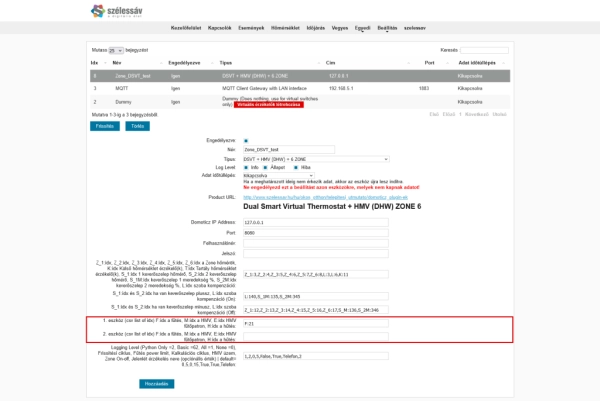
Heat source switching devices are configured in the corresponding parameter fields of the DSVT hardware settings.
The following image shows the configuration fields used for heat source switching.
Switching devices are assigned using their Domoticz device identifiers (IDX).
The corresponding configuration keys determine which heat source and operating mode each switch belongs to.
Device identifiers must be entered in the comma-separated format required by the corresponding configuration field.
Instead of editing these fields manually, using DSVT's dedicated HTML-based configuration interface is recommended.
DSVT can manage primary and secondary heat sources separately.
A typical installation may use:
The operation of the two heat sources is determined by the selected DSVT control mode.
In certain operating modes, the system can prioritise the primary heat source and use the secondary source only when specific conditions are met.
Switching conditions may depend on outdoor temperature, room heating demand, or other control parameters.
Heat source switching configuration and the heat source selection algorithm are two separate functions.
In this step, we specify which switching devices should operate when particular operating modes are activated.
The F key identifies the switching devices required for heating operation.
F:idxDomoticz switches that must be activated when heating mode starts can be assigned to this group.
Depending on the installation, these may include:
The heating switching group must be configured according to the actual hydraulic and electrical design of the heat source.
Important: a heat source switch is not the same as a room zone valve. Zone valve control and central heat source control are configured as separate functions in DSVT.
The M key identifies switching devices required for domestic hot water (DHW) production.
M:idxDuring DHW production, the heat source may require a different hydraulic configuration from that used for space heating.
The switching group may include:
The DHW switching logic must match the actual hydraulic design of the installation.
DSVT can monitor the tank temperature using the previously configured temperature sensor and start or stop DHW production according to the selected control mode.
The E key identifies the switching device used to control an electric heating element for domestic hot water production.
E:idxThe electric heating element can be used as an auxiliary heat source when operating conditions require it.
Depending on the configured control settings, DSVT can also take outdoor temperature into account when operating electric DHW heating.
The switching device may be:
Important: the electric heating element must be operated through switching equipment appropriately rated for the actual electrical load.
The heating element's own temperature limiter, overtemperature protection, and other mandatory safety devices must remain operational.
The H key identifies switching devices required for cooling operation.
H:idxThe switches required during cooling may differ from those used for heating.
Examples include:
The cooling switching group must be configured according to the requirements of the actual equipment.
For radiant cooling systems, reliable humidity measurement and dew point protection are particularly important.
Configuring cooling switches alone does not provide protection against condensation.
Operating a particular heat source or operating mode may require several switching devices to be activated together.
DSVT allows multiple Domoticz IDX identifiers to be entered in the appropriate parameter field.
Identifiers must be separated by commas according to the CSV format required by the configuration field.
This can be useful, for example, when activating a heat source also requires a motorised diverter valve to be moved into the appropriate position.
When creating switching groups, the required startup and shutdown sequence of the equipment must be considered.
Important: an IDX list does not, by itself, establish a specific timing or safety switching sequence. Such requirements must be implemented through separate control logic or suitable hardware arrangements.
An important characteristic of DSVT switching logic is that activation commands can take priority when conflicting switching requests are processed.
This means that if the same Domoticz switch receives simultaneous On and Off requests, DSVT gives priority to the active On request.
This behaviour is particularly important in systems where the same physical heat source is used by multiple operating modes.
Consider a gas boiler used both for space heating and for heating a domestic hot water tank.
When DHW production begins, the demand for space heating may temporarily stop, while domestic hot water production still requires the boiler to operate.
In this situation, two different switching requests may occur:
Because the heat source is still required for DHW production, the shared boiler switch can remain active.
Therefore, the end of space heating demand does not necessarily stop equipment that is still required by another function.
The priority of On commands is a logical rule used to manage shared switching devices.
It does not mean that all heat sources or connected equipment must operate simultaneously.
Actual heat source selection is still determined by the current DSVT operating mode, configured control parameters, and system conditions.
Important: switching priority must not override safety interlocks. Equipment safety interlocks and manufacturer-provided protection systems must function independently of DSVT switching logic.
In certain installations, the same switching device can be assigned to multiple functions.
This is appropriate, for example, when the same heat source provides both space heating and domestic hot water.
In such cases, particular attention must be paid to the following:
Assigning the same switch to incompatible operating modes is not recommended if simultaneous switching requests cannot be handled safely.
In systems using two heat sources, selecting a heat source often requires motorised hydraulic valves to operate as well.
Such installations may require:
When configuring switches, verify that sufficient water flow is available in every possible operating state.
The switching sequence of heat sources and diverter valves must be determined according to the actual hydraulic design.
Important: a heat pump or boiler must not be activated when the required water flow is unavailable.
After assigning the heat source switches, the configuration must be checked.
Pay particular attention to:
If a switch operates the wrong device, first check its IDX identifier and assignment to the corresponding function.
Following initial configuration, heating, DHW, and cooling modes should be tested separately.
Heat source switching directly affects the operation of heating, cooling, and DHW systems.
Correct electrical and hydraulic safety arrangements are therefore particularly important.
Important: DSVT is a software-based control system and does not replace the built-in safety controls of boilers, heat pumps, electric heating equipment, or other connected devices.
The sixth step in configuring DSVT is setting up the switching groups associated with primary and secondary heat sources.
The F key identifies switching devices used for heating, M for DHW production, E for the electric DHW heating element, and H for cooling.
Multiple switches can be assigned to an operating mode, for example when operating a heat source also requires motorised valves to be activated.
In DSVT switching logic, an On request can take priority over an Off request, allowing shared heat sources to operate in a coordinated manner.
Correct heat source switching configuration is essential for reliable, energy-efficient, and safe DSVT heating, cooling, and domestic hot water control.