DSVT's intelligent thermal inertia compensation uses weather forecasts to improve heating and cooling system operation.
The purpose of this function is to ensure that the controller does not respond solely to current indoor and outdoor temperatures, but also takes into account the expected outdoor temperature changes over the coming hours.
This can be particularly useful in buildings with high thermal inertia and in radiant heating and cooling systems, where room temperatures respond slowly after heating or cooling is switched on or off.
Forecast-based control can help reduce overheating, overcooling, and discomfort caused by delayed system response.
Different heating and cooling systems respond to control commands at different speeds.
A radiator system operating with relatively high supply water temperatures can change room temperatures comparatively quickly.
In contrast, underfloor heating embedded in a thick concrete screed, or other radiant heating systems with substantial thermal mass, can store significant amounts of energy. As a result, heat emission may continue long after heating has been switched off.
A similar effect occurs during cooling, as high-mass building structures require time to cool down or warm up.
A conventional thermostat responds when the measured temperature reaches a configured switching threshold.
DSVT's intelligent controller, however, can adjust the switching conditions in advance based on expected changes in outdoor temperature.
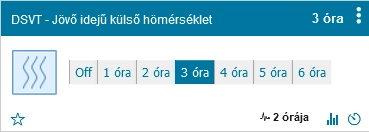
The Future Outdoor Temperature selector determines how many hours ahead the controller should look when using weather forecasts.
The available settings are:
The appropriate forecast horizon should primarily be selected according to the thermal inertia of the building and its heating or cooling system.
Suggested starting points include:
These values are indicative only. The most suitable forecast horizon depends on building insulation, the design of the heat emitters, heating and cooling capacity, and practical operating experience.
The greater the thermal inertia of the system, the more useful a longer forecast horizon may be.
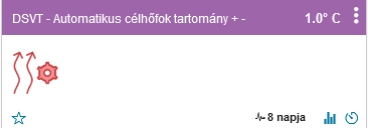
The second important parameter is the Automatic Target ± setting.
This parameter determines the maximum temperature correction that automatic control may apply to the configured switching thresholds.
For example, with a setting of 0.5°C, the calculated weather forecast-based correction is limited to ±0.5°C.
The plugin calculates a compensation value between -10 and +10 based on the expected outdoor temperature change, then scales it according to the configured maximum correction range.
The temperature compensation is calculated as follows:
Compensation = Automatic Target Range × calculated Power / 10
The result is rounded to one decimal place.
In this context, Power does not represent electrical power consumption. It is a calculated control value derived from weather forecast data.
In heating mode, DSVT compares the current outdoor temperature with the forecast temperature.
If the forecast indicates that outdoor temperature will fall, the controller may calculate a positive compensation value.
This can shift the heating switching thresholds towards higher temperatures.
As a result, the system may respond earlier to the anticipated increase in heat loss, helping reduce subsequent cooling of the rooms.
If outdoor temperature is expected to rise, the controller may calculate a negative compensation value.
In this case, the heating switching thresholds may be adjusted downwards.
This allows the controller to reduce heating demand earlier, potentially limiting subsequent overheating.
This can be particularly beneficial for underfloor heating systems that continue releasing stored thermal energy for an extended period after heating has stopped.
In cooling mode, forecast-based compensation operates with a different response to expected outdoor temperature changes compared with heating.
If outdoor temperature is expected to increase, the system calculates a positive compensation value.
Accordingly, the cooling switching thresholds may shift towards higher temperatures.
Actual cooling operation remains subject to zone target temperatures, hysteresis, and other configured restrictions.
If the forecast indicates a decrease in outdoor temperature, the controller may calculate a negative compensation value.
This can result in lower cooling switching thresholds.
Important: automatic temperature compensation does not replace dew point-based control, condensation protection, or health-oriented cooling temperature limits.
DSVT does not rely exclusively on a single forecast value when calculating temperature compensation.
The plugin calculates a weighted average using the four most recently stored future outdoor temperature values.
The latest value receives the highest weighting, while older values receive progressively lower weights.
The weighting ratio is:
4 : 3 : 2 : 1
This can reduce the impact of short-term forecast fluctuations and produce smoother changes in the calculated control compensation.
The resulting value is then applied according to the selected heating or cooling operating mode.
Intelligent forecast-based temperature compensation is disabled by default.
To enable it, select the desired forecast horizon using the Future Outdoor Temperature selector.
Then configure the maximum permitted temperature correction using the Automatic Target ± parameter.
Valid outdoor temperature measurements and weather forecast data are required for proper operation.
If suitable forecast data is unavailable, the controller uses the available data and its built-in fallback handling rules.
It is advisable to begin with a small compensation range and adjust it gradually after observing actual system behaviour.
Possible starting settings include:
These are suggested initial values for testing, not universally optimal settings.
To identify suitable parameters, monitor indoor temperature fluctuations, heat source switching frequency, and energy consumption.
Excessive compensation can cause the system to adjust its control behaviour too early or too aggressively, so gradual tuning is particularly important.
DSVT's intelligent thermal inertia compensation compares current and forecast outdoor temperatures to adjust heating and cooling switching conditions.
The user can configure both the forecast horizon and the maximum permitted temperature correction.
This allows the controller to take into account the delayed thermal response of the building and its heating or cooling surfaces.
When properly configured, forecast-based compensation can help reduce overheating, overcooling, and temperature fluctuations caused by high thermal inertia, while supporting more energy-efficient operation.