DSVT supports delayed switching On and Off of configured devices. This is particularly useful for circulation pumps, motorised valves, and auxiliary equipment that must operate in a specific sequence relative to the heat sources.
Switching delays allow the control system to be adapted to the hydraulic and operating characteristics of the installation.
In some installations, water circulation must continue for a certain period after the heat source has been switched off.
This allows residual heat to be removed from the heat source and pipework and can help the equipment cool down safely.
If an Off delay is assigned to the Domoticz switch controlling the circulation pump, DSVT does not switch it off immediately when the shutdown request occurs. Instead, the Off command is executed after the configured delay.
In hybrid systems without a hydraulic separator, it may be necessary to keep a motorised valve open for a specified period after its associated heat source has stopped.
This allows the circulation pump to remove residual heat from the heat source before the hydraulic circuit is closed.
By configuring an Off delay for the valve switch, the valve receives its closing command only after the specified time has elapsed.
Important: switching delays do not replace the manufacturer's required pump overrun, frost protection, or safety functions. The switching sequence of motorised valves and pumps must be designed according to the hydraulic configuration.
In some installations, the order in which equipment starts is also important.
For example, an auxiliary device may need to start only after another component or hydraulic device has begun operating.
An On delay allows the selected switch to receive its On command only after the configured time has elapsed following the activation request.
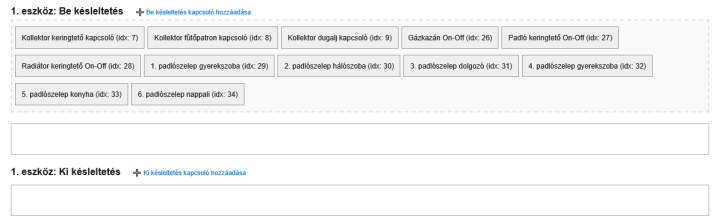
In the DSVT HTML configuration interface, the switches that use delayed On or Off commands can be selected separately for Device Group 1 and Device Group 2.
Switching delays can be assigned to individual Domoticz switches, allowing different devices within the same group to have different switching behaviour.
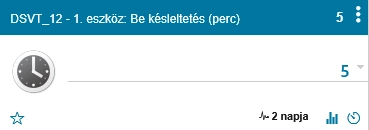
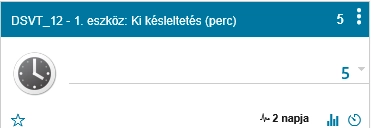
Four separate delay settings are available for the two device groups:
Selecting the switches and setting the delay duration are two separate configuration steps. The delay applies only to devices assigned to the corresponding delayed switching group.
The On delay determines how long the selected switch must wait after an activation request before receiving the On command.
For example, with a two-minute delay, the controller switches the device On only after the two-minute waiting period, provided that the command is still valid.
During the delay period, the switch remains in its previous state.
The Off delay determines how long the selected switch must wait after a shutdown request before receiving the Off command.
For example, if a five-minute Off delay is configured for a circulation pump, the pump can continue operating for up to five minutes after the heat source has stopped, provided that the heat source and pump switches are correctly configured as separate devices.
This makes it easier to implement pump overrun and can reduce the amount of residual heat remaining in the heat source.
Delay durations can be configured in the Domoticz Switches interface using the corresponding selector switches created by DSVT.
DSVT supports the following durations:
Longer durations may be useful for specialised automation tasks. Circulation pumps and motorised valves typically require considerably shorter delays.
The appropriate duration should always be selected according to the equipment manufacturer's requirements and the hydraulic characteristics of the installation.
DSVT keeps track of delayed switching commands and executes them when the configured waiting time has elapsed.
If the desired state of a switch changes during the waiting period, the controller re-evaluates the pending switching operation.
If the newly requested state already matches the switch's actual state, the previously scheduled delay can be cancelled.
This helps prevent an outdated switching command from being executed after it is no longer required.
The delay function therefore does not operate simply as an unconditional timer. It is integrated into DSVT's switch management logic.
Consider a system without a hydraulic separator, where a heat pump has a separate circulation pump and motorised valve.
A possible operating sequence is:
This is an illustrative operating sequence, not a universal procedure suitable for every installation. DSVT switching delays alone do not confirm that a valve has fully opened or that the required water flow is present. If these are safety conditions for starting the heat source, separate position feedback, flow monitoring, or suitable interlocks must be provided.
DSVT's delayed On and Off switching function allows the operation of connected devices to be coordinated over time.
Separate On and Off delays can be assigned to the two device groups, making the function suitable for various hydraulic arrangements and automation requirements.
Properly configured switching delays can support safer heat source shutdown, pump overrun operation, and coordinated control of associated equipment.