In DSVT heating and cooling mode, heat source operation, zone target temperatures, switching hysteresis, and additional control functions can be configured using separate parameters.
The system supports up to 12 independent zones. Each zone can have separate normal and economy target temperatures for both heating and cooling.
The following sections describe the most important control parameters and their operation.
Dual mode enables the coordinated operation of two heat sources. Under normal conditions, the first heat source operates, while the second can be activated when the selected control conditions require additional capacity.
The Dual temperature difference determines how far the indoor temperature must deviate from the target temperature before the second heat source is activated in indoor-temperature-based Dual control.
Setting this value to 0°C brings the activation thresholds of the two heat sources closer together. This may allow parallel operation, provided that the other control conditions are also satisfied.
If the second heat source is primarily intended to provide additional heating capacity, a difference of approximately 0.5–1°C can be used as an initial setting.
The appropriate value depends on the building's thermal inertia, the capacity of the heat sources, and the desired control behaviour.
Important: Dual mode does not replace the built-in fault monitoring of the heat sources. If the first device fails, activation of the second heat source is possible only when the required control and safety conditions are satisfied.
Short-term temperature fluctuations may otherwise cause unnecessary switching of the second heat source.
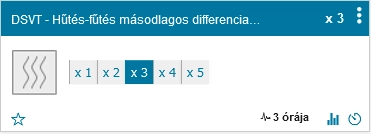
To reduce this effect, DSVT provides an averaging function that uses the average of the most recent calculated indoor temperature values for Dual control.
This setting determines how many consecutive measurements are included in the average.
For example, if temperature data is processed every five minutes, the ×3 setting uses three consecutive measurement values.
The actual time interval depends on the configured update and calculation cycles.
A higher averaging setting can reduce the effect of short-term temperature fluctuations, but it may also delay the response of the second heat source.
Dual control can also be used in cooling mode, but the direction of temperature comparisons is reversed compared with heating.
During cooling, the second device can be activated when the indoor temperature exceeds the desired target temperature by the amount defined in the selected control conditions.
In the current DSVT version, the Dual temperature difference is a shared parameter for heating and cooling heat source control.
The second cooling device may be an additional air conditioner or another compatible cooling appliance.
The configuration also supports the coordinated operation of multiple switching devices, allowing more complex control arrangements.
When configuring the system, always consider the differences between heating and cooling operation, as well as the operating limitations of the connected devices.
The heat source switching threshold determines when the controller changes the selected heat source in the corresponding outdoor-temperature-based Switch or Saver operating mode.
In heating mode, this is particularly useful when the first heat source is an air-to-water heat pump and the second is a gas boiler.
At lower outdoor temperatures, the efficiency of air-to-water heat pumps generally decreases, while the heating demand of the building may increase.
The default DSVT heating switching threshold is -5°C. However, this does not mean that every heat pump becomes uneconomical at this temperature.
The appropriate switching point should be determined according to the heat pump's COP characteristics, required supply water temperature, building heat demand, and current energy costs.
For cooling operation, the system provides a separate outdoor temperature switching threshold.
Outdoor-temperature-based switching can also use a separate hysteresis setting to reduce unnecessarily frequent changes between heat sources.
The purpose of hysteresis is to prevent minor temperature fluctuations near the target temperature from causing continuous switching.
DSVT uses separate heating and cooling hysteresis values. The controller calculates lower and upper temperature switching thresholds for individual zones.
The basic switching thresholds are:
Lower threshold = target temperature - hysteresis
Upper threshold = target temperature + hysteresis
With conventional hysteresis control:
For example, with a target temperature of 22°C and a hysteresis setting of 0.2°C, heating switches On at 21.8°C and switches Off at 22.2°C.
After switching off, the zone will not switch on again until its temperature falls to the lower threshold of 21.8°C.
Cooling control follows a similar principle, but the switching direction is reversed.
Target temperatures and switching thresholds may be further adjusted by active automatic control functions.
When selecting the appropriate hysteresis value, the thermal inertia of the heating or cooling surfaces and the response time of the zone valves should also be considered.
DSVT includes a separate room temperature balancing function.
This function allows the system to start circulation to reduce temperature differences between rooms, even when no active heating or cooling process is running.
The controller compares the lowest and highest temperatures measured by the designated room sensors.
If the difference reaches or exceeds the configured threshold and room balancing is enabled, the system can activate the configured circulation switch.
Circulation is switched off when the temperature difference falls below the threshold, or when the conditions for room balancing are no longer satisfied because heating or cooling equipment is operating.
To use this function, the appropriate room sensors and circulation device must be defined in the basic configuration, and room balancing must be enabled.
Its effectiveness depends on the hydraulic design of the installation and the heat transfer characteristics of the rooms connected through the circulation system.
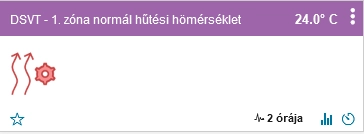
DSVT provides separate normal and economy heating target temperatures for each active zone.
The normal target temperature defines the desired room temperature during regular use.
The economy target temperature is typically lower than the normal setting. It can be used at night, during periods of absence, or when a room is used less frequently.
Both target temperatures can be configured independently for each zone.
Domoticz scheduling features can be used to automate changes to target temperature values and switching between normal and economy modes.
For example, separate daytime, night-time, and weekend temperature schedules can be configured.
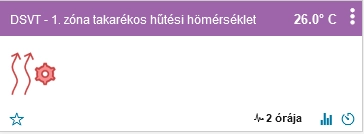
As with heating, each active zone can have separate normal and economy cooling target temperatures.
The normal cooling target temperature defines the desired room temperature during cooling operation.
The economy cooling target temperature is generally higher than the normal setting, helping to reduce cooling energy demand.
Cooling target temperatures can also be modified through scheduling or other automation conditions.
Important: before using a zone, its temperature sensor or sensors must be assigned in the basic configuration.
DSVT makes the target temperature parameters available for configured zones. Settings belonging to unused zones may remain hidden.
This improves clarity, particularly in installations that use fewer than the maximum of 12 zones.
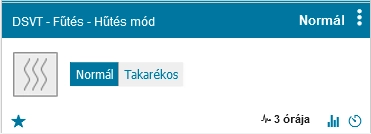
The heating and cooling operating mode selector allows users to choose between normal and economy target temperatures.
Switching can be performed:
In normal mode, the normal target temperatures are applied to the zones. In economy mode, the corresponding energy-saving target values are used.
Changing the operating mode may affect several zones simultaneously, while the target temperatures of individual zones remain independently configurable.
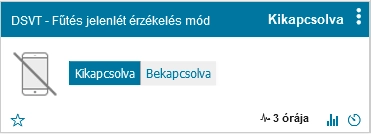
DSVT supports automatic switching between normal and economy modes through presence detection.
A properly configured presence monitoring system can provide information about whether monitored occupants are present in the building.
When presence is detected, the controller can apply normal target temperatures. During absence, it can use the economy target values.
Presence detection can, for example, be implemented by monitoring devices connected to the Wi-Fi network, provided that the necessary detection and control system is available.
Automatic presence-based operation can be enabled or disabled separately, and its activation can also be controlled through scheduling.
This allows the system to adjust heating and cooling target temperatures according to the actual occupancy of the building.
For reliable operation, heat source and zone control parameters should be configured consistently with one another.
Particular attention should be given to:
DSVT's flexible configuration allows its operation to be adapted to individual installation requirements, from simple heating systems to building services installations with multiple heat sources and independently controlled zones.
Properly configured parameters can contribute to more consistent indoor temperatures, fewer unnecessary switching operations, and improved energy efficiency.