Would you like to build your own locally controlled smart-home system, but are unsure what hardware you need – and, most importantly, how much it will cost?
You are in the right place. Szélessáv SmartHome is not an expensive, closed smart-home package. It is an open-source system that can be built gradually and integrated into your existing home and network.
You do not need to replace everything.
You do not need to automate the entire house at once.
And the software we develop is free to use.
The control hardware for a simple system, for example a 5-zone heating controller, can typically be built for approximately €140–€275.
The exact cost depends on the hardware you choose, what you can build yourself, which existing devices you can reuse, and whether any additional plumbing or electrical work is required.
The system requires a router or another compatible device capable of running OpenWrt.
We recommend the OpenWrt One. When ordered from an international online retailer, it typically costs around €125–€140.
However, using an OpenWrt One is not mandatory. Many older or second-hand routers are capable of running OpenWrt, so the central controller can sometimes be built for as little as €30–€40.
If an otherwise suitable router has limited internal storage, it may also be possible to expand it with external USB storage.
The central device can be installed behind your ISP-provided router or, with a suitable network configuration, it can even replace it. This means that the same device can manage your home network, security services and the preinstalled Domoticz smart-home system.
List of OpenWrt-compatible devices:
https://openwrt.org/toh/views/toh_fwdownload
A simple temperature sensor can be built using a D1 mini and a DS18B20 sensor. The component cost is approximately €6–€8.
If you do not want to solder or build your own device, you can use a ready-made sensor instead. For example, the Athom Tasmota-compatible temperature and humidity sensor costs approximately €9.
Athom Temperature and Humidity Sensor
For a 5-zone system, temperature sensors can therefore cost approximately €30–€55.
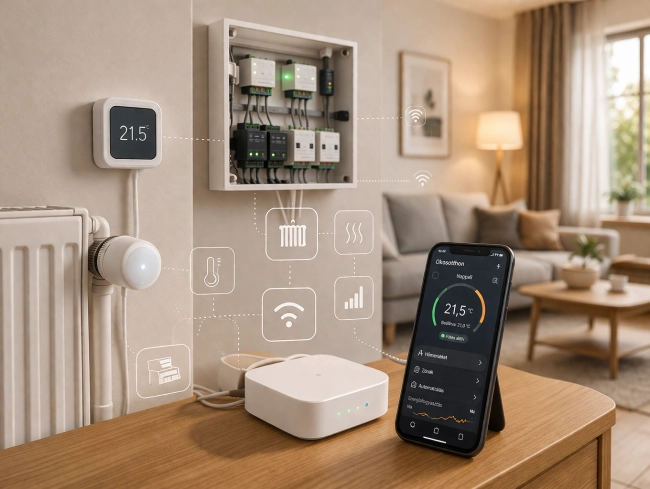
Relay outputs are required to control a boiler, zone valves, circulation pumps or other equipment.
For example, an Athom 4-channel Tasmota-compatible relay module can be used for this purpose.
One such device costs approximately €22. For a 5-zone system, two 4-channel modules may already provide enough outputs, putting the relay-control hardware in the region of €55.
In other words, the control hardware for a practical system can start at approximately €140–€275.
If you want higher-quality sensors, Zigbee devices, energy monitoring, more zones, TRVs, motorized valves or additional automation, the cost will naturally increase. The control hardware for a more advanced installation may still be built within several hundred euros, but the final cost depends heavily on the number of zones and the devices selected.
Important: the figures above are estimates for the control hardware only. They do not include the cost of any necessary plumbing modifications, motorized valves, electrical installation work or other professional installation services.
And importantly, the software we develop is open source and free to use. There is no mandatory subscription or monthly fee.
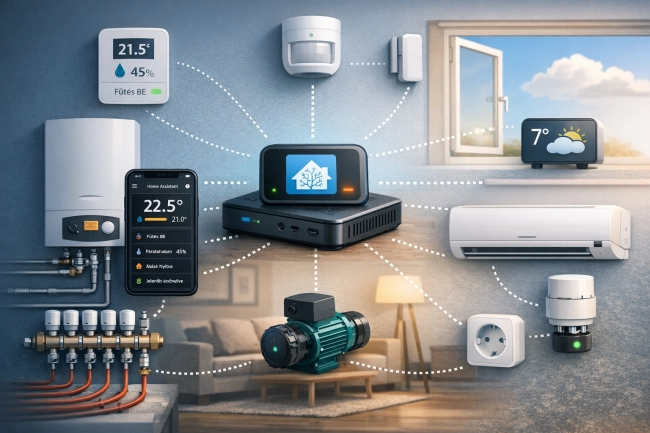
The heart of the system is a low-power device running OpenWrt. It also runs the smart-home control software, which collects data, makes decisions and controls connected devices.
Its tasks can include:
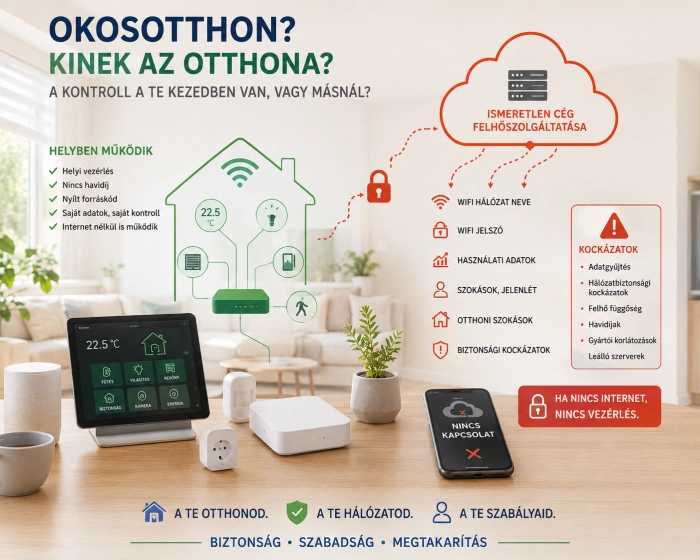
The system runs locally, so its essential functions do not require an external cloud service.
For the system to operate intelligently, it needs to know what is happening inside and around your home. It therefore uses information from various sensors and data sources.
Typical sensors and data sources include:
The more accurate information is available, the better the automation can adapt to current conditions.
The system does more than simply monitor data – it can also take action. This is what makes it useful: instead of merely displaying information, it actively controls systems in the home.
Examples of devices that can be controlled include:
The devices communicate over a common network. This can use Wi-Fi, wired Ethernet, Zigbee, or a combination of these technologies.
The goal is always to provide stable and reliable operation while ensuring that essential home functions do not depend on the availability of an external cloud service.
A significant part of the low-voltage sensor installation and smart-home configuration can be done yourself. However, 230/400 V electrical work and any required plumbing modifications should be carried out by appropriately qualified professionals.
Professional assistance may be required for tasks such as:
In many cases, however, an existing heating or electrical system can simply be extended with sensors and control devices, so a complete system replacement is not necessarily required.
You do not need to automate the entire house immediately. In fact, it is usually better to build the system gradually.
A first project could be as simple as measuring the temperature in one room and then controlling a boiler or zone valve. From there, the system can be expanded step by step.
This is not a closed, boxed product that requires you to buy every device from one manufacturer. The goal is exactly the opposite: to allow you to choose the right device for each individual task.
If you do not want to spend a long time researching which devices you need and how to begin, our documentation guides you through the first steps.
Whether you are starting with a small system costing around €100–€150 or planning a more advanced heating, cooling and energy-management solution, it is worth getting the foundations right.
Not sure where to start? Take a look at the installation steps and recommended hardware, or contact us if you need help choosing a suitable starting point for your home.