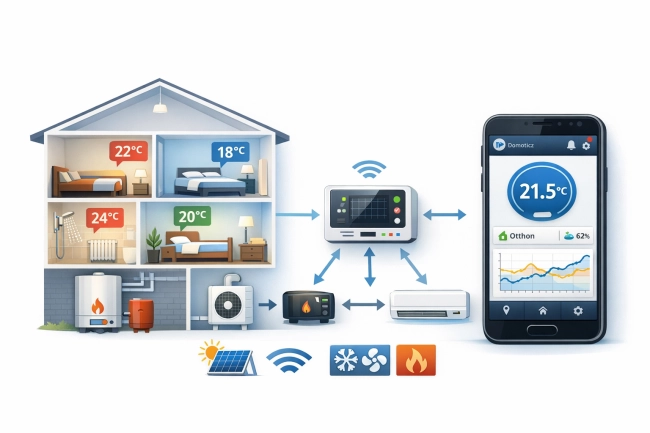

DSVT (Dual Smart Virtual Thermostat) is an open-source multi-zone heating and cooling control system designed primarily for existing homes. It manages heating and cooling demand room by room, can coordinate multiple heat sources, and can take upcoming weather changes into account.
The goal of DSVT is not simply to let you adjust the temperature remotely. It manages the heating and cooling operation of the entire building: it monitors room temperatures, determines the demand of individual zones, controls the corresponding valves or other actuators, and can also control the central heat source when required.
The system is primarily intended for retrofitting existing homes. It is open source, runs locally, requires no mandatory manufacturer cloud service and has no subscription fee.
A conventional thermostat usually switches the entire heating system on or off based on the temperature measured in a single room. In a family home, however, the heating demand of different rooms is rarely identical.
The ideal temperature in the living room may be different from the bedroom, bathroom or a rarely used room. DSVT therefore does not operate as a single thermostat, but treats individual rooms as separate control zones.
The system can manage up to 12 independently controlled zones by default, and the control system can be extended further. Each zone can have its own temperature sensor and its own target temperature.
DSVT determines which zones require heating or cooling, controls the corresponding valves or other actuators, and then controls the central heating or cooling source according to the combined demand of the zones.
One of DSVT's special capabilities is the coordinated control of different heat sources. In existing homes, it is common for an existing gas boiler to remain in operation after a heat pump has been installed.
The two systems do not need to operate independently. Based on configured conditions, DSVT can automatically select which heat source should operate in a given situation.
The decision can be based, for example, on outdoor temperature or other configured conditions.
The objective: use the appropriate heat source, in the appropriate room, at the appropriate time.
The control system is not limited to boilers and heat pumps. Air conditioners controlled by infrared remote control can also be integrated, for example using a Tasmota-based IR controller.
This makes it possible to include a conventional air conditioner, even one without built-in smart-home integration, in the central heating and cooling logic.
Underfloor, wall and other radiant heating systems have significant thermal inertia. The heated building structure continues to release stored heat even after the heating system has been switched off, so the room temperature may continue to rise.
This can easily lead to overheating, particularly when the outdoor temperature rises rapidly or strong sunshine arrives.
DSVT can also use weather forecast data. If the system detects that outdoor conditions are expected to change significantly, it can reduce heating or cooling demand earlier.
DSVT can be used to modernise existing homes without necessarily replacing the entire heating system or installing a completely new building automation infrastructure.
Wireless temperature sensors, motorised valves, relays and other control devices can be added gradually to the existing system.
You do not need to automate the entire house at once. The system can start with only a few zones and be expanded later.
Separate comfort and economy target temperatures can be configured for individual rooms. These settings can follow not only a schedule, but also the actual use of the home.
The system can detect whether somebody is at home using network or Wi-Fi presence detection, and switch between comfort and economy operation accordingly.
DSVT is part of the Szélessáv SmartHome project. It runs on an OpenWrt-based device using Domoticz as the home automation controller together with custom-developed control logic.
If the home also has a photovoltaic system, the control logic can be adapted to increase the local use of surplus solar energy. Target temperatures or operating modes can be adjusted to make better use of locally generated electricity.
One of the next development directions for DSVT is to determine not only which heat source should be used, but also when energy should be consumed.
Future versions may use information such as dynamic electricity tariffs, expected heat-pump efficiency, solar production or the state of charge of a home energy storage system.
This is currently a development direction and is not yet a finished feature of the system.
DSVT is more than a remotely adjustable thermostat. It manages the heating and cooling demand of multiple rooms within one system, can coordinate different heat sources, can take upcoming weather changes into account, and can be installed gradually in existing homes.
The objective is to create a heating and cooling control system that adapts to the actual requirements of the building while remaining open, locally operated and extensible over the long term.