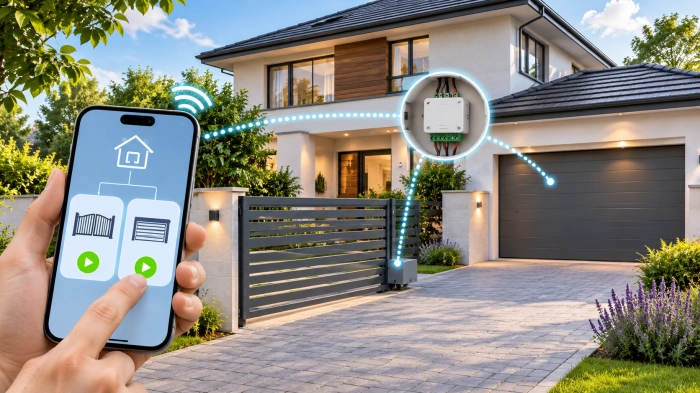
Integrating an existing electric gate or garage door into a smart home system generally does not require replacing the entire gate controller. With a suitable relay and the Domoticz system, the existing controller can easily be extended with smartphone-based remote control.
There are many everyday situations in which controlling a gate or garage door from a smartphone can be useful:
Integrating the existing gate controller into the Szélessáv SmartHome system can provide a simple and practical solution for these situations.
The solution is based on a dry-contact relay, also known as a potential-free or volt-free relay. This type of relay does not supply its own voltage through its switching contacts. Instead, it simply opens or closes an electrical circuit, much like a conventional mechanical push button.
The relay briefly closes the appropriate input terminals on the gate or garage door controller, just as if someone had pressed a wall-mounted push button.
In Domoticz, the relay can be displayed as a virtual push button, allowing the gate to be operated from a computer, tablet or smartphone directly through a web browser.
Existing radio remote controls and physical push buttons remain fully functional. The smart home system does not replace the existing gate controller but extends it with an additional control option.
Most electric gate and garage door controllers provide an input designed for connecting an external push button or another control device.
This is often a step-by-step input, where successive switching pulses initiate opening, stopping or closing.
More advanced gate controllers may provide several independent control inputs:
Using a multi-channel dry-contact relay, the available functions can be displayed and operated independently within the Domoticz interface.
For example, a single multi-channel relay can be used to control full driveway gate opening, pedestrian opening and garage door operation, provided that the respective controllers support these functions.
The gate controller input generally does not need to remain continuously closed. Instead, it is activated by a short switching pulse.
By configuring the switching duration to, for example, one second, the relay replicates the operation of a conventional physical push button. From the gate controller's perspective, a command initiated from a smartphone is equivalent to someone pressing the wall-mounted button.
For relays running Tasmota firmware, automatic switch-off can be configured directly on the relay using the PulseTime function.
We recommend configuring the pulse duration directly on the relay itself. This ensures that the relay switches off automatically even if the network connection is interrupted after the switching command has been issued or the Domoticz system temporarily becomes unavailable.
The required pulse duration must be determined according to the gate controller manufacturer's documentation. The relay must also be configured to remain switched off after a power failure, preventing unexpected gate movement when power is restored.
Both Wi-Fi and Zigbee-based dry-contact relays can be used for gate control. The most suitable solution depends primarily on the location of the gate and the coverage of the local network.
If the gate or garage is located close to the house and wireless network coverage is sufficient, a Wi-Fi-based relay can easily be integrated into the existing system.
For the Szélessáv SmartHome system, we primarily recommend devices running Tasmota firmware. These devices can be controlled directly over the local network without requiring the manufacturer's cloud service, a separate user account or a subscription.
Where suitable Zigbee network coverage is available, a Zigbee-based dry-contact relay can also be used.
Zigbee network coverage can be extended, if necessary, using mains-powered Zigbee devices that also function as network routers.
When selecting the appropriate technology, the distance to the gate, building structures and the signal attenuation caused by metal controller enclosures should also be considered.
If the gate or garage is located further away from the house and wireless connectivity is unreliable, Powerline networking may provide an alternative solution.
Powerline adapters use existing electrical wiring for data communication. Since the gate's electrical supply often comes from the house, local network connectivity can potentially be extended to the gate or garage without installing a separate network cable.
A Powerline adapter with an integrated Wi-Fi access point can also provide wireless network coverage around the gate.
The quality of a Powerline connection depends on the electrical installation, cable length, electrical phases and interference. Its suitability should therefore be verified on site.
One of the important advantages of Domoticz is the ability to configure individual access permissions for different users.
A user account can be created that provides access only to selected gate control switches, without granting access to the other functions of the smart home system.
A trusted neighbor or family member can be granted permanent access, while temporary user accounts can be created for contractors and removed once their work has been completed.
Domoticz records switch operations, allowing the time of previously issued switching commands to be reviewed.
One of the core principles of the Szélessáv SmartHome system is that home automation should operate locally, within the user's own network, whenever possible.
Communication between a compatible relay and the Domoticz system does not require an external cloud service. Local gate control can therefore remain operational even if the internet connection is temporarily unavailable.
For remote access over the internet, we primarily recommend using a VPN connection. Two-factor authentication, available from Domoticz 2026, can provide an additional security layer for user access.
The solution described here issues a switching command that replicates the operation of a conventional push button. It does not monitor the actual movement or final position of the gate. Therefore, the state of the Domoticz switch does not indicate the physical position of the gate.
When operating a gate remotely, it is essential to ensure that its movement does not endanger nearby people, animals or vehicles.
All existing gate safety devices, including photoelectric safety sensors, obstacle detection systems and other protective functions, must remain fully operational.
When connecting equipment to gate or garage door controllers, the manufacturer's documentation and applicable electrical safety requirements must always be followed. Connections to the controller board should only be carried out by a suitably qualified person, electrician or gate automation specialist where necessary.
The objective is not to replace the existing gate controller or its safety functions, but to provide a simple, safe and cloud-independent smart home integration of the existing control system.