ASC (Automatic Shutter Controller) provides vibration-based protection for motorized shutters and shading systems. This feature is primarily designed for outdoor shading structures that may be exposed to significant mechanical stress during strong winds or sudden gusts.
Large fabric screens, awnings, and certain pergola shading systems can transfer substantial forces to their supporting structures in strong winds. Sudden loads may cause deformation, mechanical damage, or even structural failure.
Vibration detection allows ASC to automatically move the shading system to a protective position when abnormal structural movement is detected, helping reduce the risk of damage.
The protection system uses a vibration sensor connected to Domoticz, such as a Zigbee vibration sensor.
The sensor should be installed on a part of the shading structure where wind-induced movement can be reliably detected. This is often a freely moving section farther from the mounting points, such as the bottom bar of a fabric screen.
When positioning the sensor, consider the movement of the structure, secure mounting, weather protection, and the reliability of the wireless connection.
When the sensor detects an event matching the configured criteria, ASC initiates a protective movement command. This protection takes priority over normal temperature- and light-based shutter control.
If multiple shading devices are assigned to a single ASC controller, the protective command can apply to all associated devices, allowing coordinated protection.
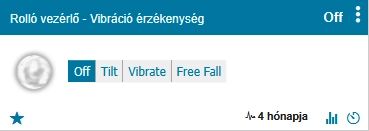
ASC provides a dedicated Domoticz selector switch for configuring vibration detection.
The Vibration sensitivity setting determines which sensor events trigger protective operation. Depending on the sensor and its Domoticz integration, these events may include vibration, tilt, or free fall.
The purpose of this setting is to detect potentially dangerous structural movement while minimizing unnecessary shutter movements caused by minor, harmless vibrations.
Sensitivity and supported event types should always be configured according to the characteristics of the sensor and shading structure.
Wind gusts often occur repeatedly at short intervals. If the system immediately returned to normal operation after every vibration event, the shading structure could move back and forth unnecessarily.
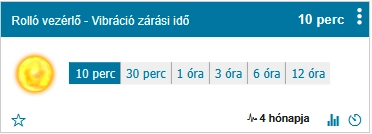
To prevent this behavior, ASC provides the Vibration closing time setting.
The configured duration determines how long vibration protection remains active after a detected event.
During this period, normal automatic control cannot restore a shutter position that conflicts with the protective position.
Once the protection period expires, and provided no new protective event or other blocking condition is active, the controller can return to normal operation.
ASC creates a separate Vibration status alert device, which can also be displayed on the Domoticz dashboard.
This alert allows users to check whether vibration protection is currently active and understand why the shading system may be positioned differently from the value selected by normal automatic control.
Displaying the protection status is particularly useful when a single ASC controller manages multiple shading devices or when the configured protection duration keeps the structure in its protective position for an extended period.
Vibration-based protection can be particularly useful for:
A conventional anemometer measures the speed of moving air. A vibration sensor, by contrast, reacts directly to movement or vibration of the shading structure itself.
This distinction is important because the mechanical load on a shading structure does not depend solely on wind speed. Wind direction, building geometry, shading dimensions, structural rigidity, and mounting conditions can all affect how the structure responds.
With an appropriately selected and configured sensor, vibration protection may detect localized structural movement that would not be identified by a remotely located anemometer or a weather forecast.
The two protection methods complement one another: wind speed-based protection monitors measured or forecast wind conditions, while vibration-based protection responds to actual movement of the shading structure.
Reliable vibration detection requires a stable Zigbee or other supported communication connection, secure sensor mounting, and correctly configured Domoticz integration.
The system's response time depends on the sensor, wireless communication, Domoticz event processing, and the ASC update cycle. Therefore, this feature should not be considered a guaranteed instantaneous or safety-certified protection mechanism.
Important: ASC vibration protection is a supplementary automation feature. It does not replace mechanical or electrical safety measures required by the shading system manufacturer. The protective position and system operation should be verified after installation.
When properly configured, vibration-based protection can help reduce the risk of damage caused by strong winds and abnormal structural movement while allowing normal automatic shutter control to continue according to temperature, light intensity, and presence settings.