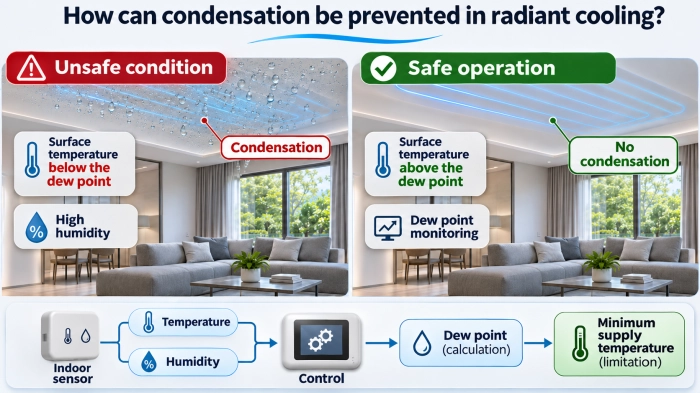
One of the most important technical requirements of ceiling, wall and underfloor cooling systems is the prevention of condensation. When the temperature of a cooled surface falls below the dew point of the surrounding indoor air, water vapour may condense on the surface. This can cause not only aesthetic problems but also moisture accumulation, mould growth and long-term damage to building structures.
Effective radiant cooling control therefore requires more than simply measuring room temperature. Relative humidity, the dew point calculated from these measurements and the supply cooling water temperature must also be considered.
The DSVT heating and cooling control system, developed by the Szélessáv Public Benefit Foundation, supports dew point-based supply water temperature control using appropriate sensors and motorised mixing valves.
Radiant cooling uses large internal building surfaces to cool individual rooms. Water at a lower temperature than the indoor air circulates through pipes embedded in ceilings, walls or floors.
The cooled surface absorbs thermal energy from the room, which is then removed by the circulating water. The required cooling water can be produced, for example, by a reversible air-to-water heat pump.
The main types of radiant cooling include:
Unlike conventional air conditioning systems, radiant cooling operates over large surface areas using relatively small temperature differences.
Potential advantages include:
However, the suitability and available cooling capacity of radiant cooling systems are significantly influenced by indoor humidity and the associated risk of condensation.
Air always contains a certain amount of water vapour. The amount of water vapour that can be present without reaching saturation depends on the air temperature.
Warmer air has a higher saturation vapour pressure, while at lower temperatures saturation occurs at a lower water vapour content.
When warm, humid air comes into contact with a cold surface, the air immediately adjacent to that surface cools. If its temperature reaches the saturation temperature, some of the water vapour may condense into liquid water.
This phenomenon can frequently be observed in everyday situations:
The same physical process can occur on excessively cooled ceiling, wall or floor surfaces.
The dew point is the temperature to which air must be cooled, without changing its water vapour content or pressure, to reach saturation.
At the dew point, relative humidity reaches 100%. Further cooling may result in condensation.
Two fundamental measurements are required to determine the dew point:
Using these two measurements, the dew point temperature can be calculated mathematically.
If the temperature of a cooled surface falls below the dew point of the surrounding air, condensation may occur.
If the surface temperature remains above the dew point with an appropriate safety margin, the risk of condensation can be significantly reduced.
The objective of radiant cooling is therefore not to achieve the lowest possible cooling water temperature, but to utilise the available cooling capacity safely.
At the same room temperature, higher relative humidity results in a higher dew point.
This means that condensation can occur on relatively warmer surfaces when the indoor air contains more moisture.
The following table illustrates approximate dew point temperatures at different relative humidity levels in a room with an air temperature of 26 °C.
| Room temperature | Relative humidity | Dew point | Example supply temperature target with +2 °C compensation |
|---|---|---|---|
| 26 °C | 40% | 11.3 °C | 13.3 °C |
| 26 °C | 45% | 13.1 °C | 15.1 °C |
| 26 °C | 50% | 14.8 °C | 16.8 °C |
| 26 °C | 55% | 16.3 °C | 18.3 °C |
| 26 °C | 60% | 17.6 °C | 19.6 °C |
| 26 °C | 65% | 18.9 °C | 20.9 °C |
| 26 °C | 70% | 20.1 °C | 22.1 °C |
| 26 °C | 75% | 21.2 °C | 23.2 °C |
| 26 °C | 80% | 22.3 °C | 24.3 °C |
The dew point values shown in the table are approximate calculated values. The +2 °C compensation is an illustrative example, not a universal safety or design requirement. The calculated supply temperature target may also be subject to additional operating and comfort limitations.
The table demonstrates how significantly the suitable cooling water temperature can change as relative humidity increases.
At 50% relative humidity, the dew point is approximately 14.8 °C. At 80% relative humidity, however, it increases to approximately 22.3 °C.
The higher dew point can significantly reduce the available cooling capacity of a radiant cooling system.
Several mathematical equations are available for calculating the dew point. Within typical indoor temperature ranges, an approximate version of the Magnus formula can be used.
γ = ln(RH / 100) + (17.62 × T) / (243.12 + T)
Td = (243.12 × γ) / (17.62 − γ)
Where:
The calculation can be performed automatically using measurements from an appropriate temperature and humidity sensor.
An intelligent heating and cooling control system can therefore continuously monitor the current dew point values of individual rooms and adjust cooling operation when necessary.
Simpler radiant cooling installations often operate with a fixed supply water temperature, such as 18 °C or 20 °C.
Although such settings may be appropriate under certain conditions, they do not automatically account for changes in indoor humidity.
Indoor humidity can change throughout the day for several reasons:
Assume that a room equipped with ceiling cooling has an indoor temperature of 26 °C and a constant cooling water supply temperature of 18 °C.
| Condition | Relative humidity | Dew point | Supply water temperature | Temperature difference relative to dew point |
|---|---|---|---|---|
| Drier indoor air | 45% | 13.1 °C | 18 °C | +4.9 °C |
| Increasing humidity | 60% | 17.6 °C | 18 °C | +0.4 °C |
| High humidity | 70% | 20.1 °C | 18 °C | −2.1 °C |
| Very high humidity | 80% | 22.3 °C | 18 °C | −4.3 °C |
The unchanged supply water temperature may initially be appropriate. However, as indoor humidity increases, the available safety margin decreases and the water temperature may eventually fall below the dew point.
This does not automatically mean that the ceiling surface itself has fallen below the dew point. Nevertheless, condensation risks may develop on colder pipes, fittings and certain parts of the cooled surface.
A supply water temperature that is appropriate in the morning may present a condensation risk later in the afternoon as indoor humidity increases.
Dynamic dew point-based control allows the cooling water target temperature to adapt to current indoor conditions.
From the perspective of condensation, the actual temperature of the surface in contact with the surrounding air is the most important factor.
The surface temperature of a ceiling, wall or floor does not necessarily correspond to the temperature of the water circulating within it.
The difference between these temperatures is influenced by several factors:
Maintaining the supply cooling water temperature above the dew point can therefore provide a conservative and practical control strategy that can also reduce condensation risks on cold pipework.
However, this does not replace appropriate mechanical system design, correct sensor positioning or the required vapour-tight pipe insulation.
In a multi-zone radiant cooling system, the temperature and relative humidity of individual rooms may differ considerably.
If several rooms receive cooling water from a common supply pipe, the dew point of a single room is not necessarily sufficient to determine an appropriate supply temperature target.
The following table illustrates a possible operating condition in a multi-zone residential building.
| Room | Temperature | Relative humidity | Calculated dew point |
|---|---|---|---|
| Living room | 26 °C | 50% | 14.8 °C |
| Bedroom | 25 °C | 55% | 15.3 °C |
| Home office | 27 °C | 45% | 14.1 °C |
| Kitchen | 27 °C | 60% | 18.6 °C |
| Bathroom | 27 °C | 70% | 21.1 °C |
In this example, the dew point in the living room is only 14.8 °C, while the bathroom dew point reaches 21.1 °C.
If the central controller considered only measurements from the living room, it could permit a supply water temperature that presents a condensation risk in other rooms.
When a common cooling water supply is used, it is therefore important to consider the highest relevant dew point rather than simply averaging the dew point values of individual rooms.
The DSVT multi-zone heating and cooling control system supports up to 12 independent zones.
Using measurements from appropriately configured indoor temperature and humidity sensors, the dew point values of individual rooms can be calculated.
In its dew point-based mixing valve control mode, DSVT uses the highest available indoor dew point value to determine the supply cooling water temperature target.
In dew point-based control mode, the mixing valve temperature target is calculated by adding the configured compensation value to the highest available indoor dew point.
Supply temperature target = Highest indoor dew point + Mixing valve compensation
The compensation value allows an appropriate temperature difference to be maintained between the calculated dew point and the target supply cooling water temperature.
Rather than operating with a fixed, predefined cooling water temperature, DSVT can dynamically adjust the mixing valve target according to current indoor conditions.
Assume that the highest indoor dew point is 16 °C and the configured mixing valve compensation is +2 °C.
16 °C + 2 °C = 18 °C
In this case, the calculated dew point-based supply temperature target is 18 °C.
If indoor humidity subsequently increases and the highest dew point reaches 19 °C, the new temperature target becomes:
19 °C + 2 °C = 21 °C
The system can therefore respond to increasing humidity by raising the cooling water temperature target rather than necessarily switching off the entire cooling installation immediately.
Where the mechanical system permits, cooling may continue at reduced capacity.
The calculated dew point represents a theoretical condensation threshold. In an actual radiant cooling installation, several factors may make it inappropriate to operate the cooling water supply at exactly this temperature.
These factors may include:
The purpose of positive dew point compensation is to reduce the impact of these uncertainties.
The required compensation must be determined according to the characteristics of the mechanical installation, sensor accuracy, control response time and additional protective measures.
A larger compensation value may reduce the risk of condensation, but it also reduces the available cooling capacity of the radiant cooling system.
One possible method of regulating the supply cooling water temperature is to use a motorised mixing valve.
An appropriately designed mixing circuit can combine colder water supplied by the heat pump or buffer tank with warmer water returning from the cooling distribution system.
By adjusting the mixing ratio, an appropriate supply water temperature can be maintained for the radiant cooling circuit.
The fundamental components of this control arrangement include:
If the measured supply water temperature differs from the calculated target temperature, DSVT can adjust the motorised mixing valve position according to the configured control parameters.
Correct operation requires appropriate mixing valve orientation, correct positioning of the supply temperature sensor and suitable hydraulic system design.
More complex building services installations may contain several different types of heat emitters and cooling equipment.
For example, the same building may contain:
These cooling technologies may require different supply water temperatures and operating conditions.
DSVT supports the control of two independent motorised mixing valves. Separate control parameters and dew point compensation values can be assigned to each mixing valve.
| Parameter | Mixing valve 1 | Mixing valve 2 |
|---|---|---|
| Cooling system | Ceiling cooling | Underfloor cooling |
| Highest indoor dew point | 17 °C | 17 °C |
| Example dew point compensation | +2 °C | +4 °C |
| Calculated supply temperature target | 19 °C | 21 °C |
The table illustrates an example configuration. Actual supply temperature targets and compensation values must be determined according to the technical and comfort requirements of the cooling systems.
Using two independent mixing valves allows the same central cooling installation to provide different supply water temperatures for separate cooling circuits.
→ DSVT technical documentation and mixing valve control
Various dew point switches and condensation sensors can be used to protect radiant cooling installations.
Certain types of these devices detect conditions associated with condensation risk and interrupt cooling operation when necessary.
This is an important protective function, particularly if the central controller malfunctions or a sensor provides incorrect measurement data.
Continuous dew point-based supply temperature control, however, performs a different function.
| Characteristic | Basic condensation protection shutdown | Dynamic dew point-based control |
|---|---|---|
| Control action | Stops or restricts cooling | Adjusts the supply water temperature |
| Response to changing humidity | When a threshold is reached | Continuous adaptation |
| Cooling at reduced capacity | Depends on equipment and configuration | Possible under suitable hydraulic conditions |
| Protective role | Can be implemented as an independent safety function | Normal operating control |
| Consideration of multiple rooms | Installation-dependent | Based on available indoor dew point values |
These two approaches are not necessarily alternatives. Independent condensation sensors and protective shutdown functions can also be used alongside dynamic dew point-based control.
During summer, opening windows can allow considerable amounts of humid outdoor air to enter the building.
This can be particularly problematic during warm, humid or stormy weather.
If the cooled surfaces within the room are still at a relatively low temperature while the incoming air has a higher dew point, condensation risks may develop within a short period.
DSVT can also consider the status of door and window sensors assigned to individual zones.
With an appropriate configuration, cooling operation in the affected zone can be restricted or temporarily suspended when a window is open, while other zones may continue operating.
However, the thermal inertia of radiant cooling systems must also be considered. Previously cooled ceilings and walls do not warm up immediately after the cooling circuit has been closed.
Open window detection is therefore a useful supplementary control function, but it is not a substitute for dew point protection.
One fundamental characteristic of radiant cooling is that, during normal condensation-free operation, it does not remove significant amounts of water vapour from indoor air.
Conventional air conditioners and appropriately designed fan coil units, in contrast, may operate with cold heat exchangers on which moisture from the air condenses.
The resulting condensate is removed through a dedicated collection and drainage system.
Radiant cooling installations do not generally provide condensate drainage from ceilings, walls or floors. Preventing condensation on these surfaces is therefore a fundamental requirement.
When indoor humidity is high, increasing the cooling water temperature reduces the available radiant cooling capacity. Under such conditions, separate dehumidification equipment or an air handling system capable of dehumidification may also be necessary.
| Cooling technology | Sensible cooling | Dehumidification | Condensate drainage |
|---|---|---|---|
| Ceiling cooling | Yes | No | Not intended for normal operation |
| Wall cooling | Yes | No | Not intended for normal operation |
| Underfloor cooling | Yes | No | Not intended for normal operation |
| Conventional air conditioner | Yes | Yes, under appropriate operating conditions | Required |
| Fan coil unit | Yes | Depends on cooling water temperature and equipment design | Required during wet operation |
| Standalone refrigerant dehumidifier | No, generally releases heat into the room | Yes | Required |
Reducing the water vapour content of indoor air also lowers the dew point.
With a lower dew point, lower supply cooling water temperatures may be used under appropriate operating conditions, potentially increasing radiant cooling capacity.
Coordinated operation of radiant cooling and dehumidification can therefore provide a more comfortable and controllable indoor environment.
Outdoor and indoor dew point temperatures describe the moisture conditions of two different environments.
The indoor dew point can be used directly to assess the condensation risk associated with cooled surfaces within individual rooms.
The outdoor dew point, in contrast, provides information about the moisture content of the outdoor air.
When the outdoor dew point is high, ventilation may increase indoor moisture content. When the outdoor dew point is lower than the indoor dew point, ventilation may reduce indoor moisture content under suitable conditions.
| Characteristic | Indoor dew point | Outdoor dew point |
|---|---|---|
| Measurement environment | Rooms within the building | Outdoor air |
| Direct radiant cooling control | Fundamentally important | Insufficient on its own |
| Assessment of ventilation moisture effects | Compared with outdoor conditions | Compared with indoor conditions |
| Heat source selection conditions | Depends on control strategy | Can be used in certain DSVT operating modes |
DSVT indoor dew point-based mixing valve control should not be confused with heat source selection functions that use the outdoor dew point.
Protecting cooled indoor surfaces against condensation primarily requires appropriate indoor measurement data.
Like radiant heating systems, radiant cooling installations can have considerable thermal inertia.
A substantial delay may occur between the appearance of cooling demand and the actual cooling of the ceiling, wall or floor. The same applies to the warming of these surfaces after cooling has stopped.
DSVT weather forecast-based predictive control can take expected outdoor temperature changes over the next few hours into account and adjust the switching thresholds of cooling zones accordingly.
This can help the cooling system prepare earlier for expected increases in outdoor temperature and reduce cooling demand in advance when outdoor temperatures are expected to decrease.
These two control functions perform different tasks:
By combining these functions, cooling operation can be better adapted to the thermal characteristics of the building and current indoor conditions.
→ What is the difference between weather-compensated and predictive heating control?
In addition to dew point-based control, DSVT supports an indoor cooling temperature limitation based on outdoor temperature.
The purpose of this function is to prevent the difference between the indoor cooling target temperature and the outdoor temperature from exceeding a configured value.
This comfort-oriented function is not the same as dew point protection.
These functions complement each other but perform different control tasks.
Dew point-based radiant cooling control requires appropriate measurement data, controllable mechanical equipment and a central controller.
| Equipment | Function |
|---|---|
| Indoor temperature sensor | Measures the current room temperature |
| Indoor humidity sensor | Measures relative humidity for dew point calculation |
| Combined temperature and humidity sensor | Provides both required indoor measurements |
| Supply water temperature sensor | Measures the water temperature controlled by the mixing valve |
| Return water temperature sensor | Monitors cooling circuit operation and temperature differences |
| Motorised mixing valve | Controls the supply cooling water temperature |
| Circulation pump | Provides appropriate water circulation |
| Zone valves | Independently open and close individual cooling circuits |
| Door and window sensors | Support cooling demand control when doors or windows are open |
| Surface temperature sensor | Monitors temperatures of critical cooled surfaces |
| Independent condensation sensor | Provides supplementary protective functions |
| OpenWrt router or another compatible Domoticz controller | Runs the local control software |
| DSVT control software | Coordinates cooling zones and mixing valve control |
The exact equipment requirements depend on the mechanical installation and the selected control strategy. Not every sensor and component listed above is required in every system.
When upgrading existing buildings, wireless Zigbee or Wi-Fi temperature and humidity sensors can often eliminate the need to install new measurement signal cables.
The accuracy of dew point-based control depends significantly on the positioning and measurement accuracy of the sensors.
Sensors used to measure general room temperature and humidity should be installed in locations where they can measure representative indoor air conditions.
To obtain representative measurements, the following locations should generally be avoided:
However, areas with increased condensation risks may also require dedicated local humidity, surface temperature or condensation sensors.
Correct radiant cooling operation requires not only accurate measurements but also continuously available and reliable measurement data.
A depleted wireless sensor battery, communication failure or incorrect measurement may prevent the controller from receiving reliable information about the current condition of a room.
Missing humidity data does not mean that there is no condensation risk in the affected room.
Appropriate system design should therefore address several requirements:
Using the highest available dew point provides a suitable basis for control only when reliable measurements are available from the relevant rooms served by the cooling system.
Software-based dew point control does not replace independent protective measures required by the mechanical installation or appropriate handling of sensor failures.
Condensation is not limited to ceilings, walls and floors.
Condensation may also develop on the external surfaces of pipes carrying cold water, manifolds, valves, circulation pumps and buffer tanks.
This is particularly important in installations where the heat pump produces cooling water at a lower temperature than the water supplied to the radiant cooling circuits through a mixing valve.
The surface temperature of colder pipework between the heat pump and the mixing valve may fall below the dew point of the surrounding air.
Cold mechanical components exposed to condensation risks must be provided with appropriately sized, continuous, vapour-tight thermal insulation.
Particular attention should be paid to insulation joints, pipe supports, fittings and other components that may interrupt the continuity of the insulation.
The consequences of condensation in radiant cooling installations depend on the extent and duration of moisture exposure and the affected building materials.
Potential problems include:
Persistently high relative humidity can also create unfavourable conditions for certain building materials, even when visible water droplets are not present.
Condensation protection must therefore be considered during the design and installation of radiant cooling systems.
During cooling operation, higher cooling water temperatures generally provide more favourable operating conditions for heat pumps because the required temperature difference between the cooled water and the outdoor environment is reduced.
Excessively low cooling water temperatures can therefore increase both condensation risks and the energy required for heat pump operation.
Dew point-based control can help adapt the radiant cooling supply water temperature to current indoor conditions.
However, it is important to distinguish between the supply water temperature controlled by the mixing valve and the cooling water temperature actually produced by the heat pump.
If the heat pump continuously produces very cold water that is subsequently mixed with warmer return water, mixing valve control alone does not automatically improve heat pump efficiency.
Energy efficiency optimisation requires coordinated assessment of the heat pump, cooling circuits, mixing valves and circulation pumps.
Many existing radiant cooling installations can subsequently be upgraded with dew point-based control.
If the existing installation already includes a motorised mixing valve and a supply water temperature sensor, the upgrade may primarily involve adding an appropriate controller and indoor sensors.
Using the Szélessáv Smart Home system and DSVT, existing compatible temperature sensors, humidity sensors, relays, motorised valves and other mechanical equipment can also be integrated into the central control system.
Replacing the existing heat pump, radiant cooling pipework or the entire mechanical installation is not necessarily required.
However, before upgrading the system, the existing hydraulic design, motorised valve compatibility, sensor suitability, cold pipe insulation and applicable safety requirements must be assessed.
→ How can an existing heating system be converted into a multi-zone system?
The Szélessáv Smart Home system is built on the open-source OpenWrt and Domoticz platforms.
The DSVT control algorithm runs locally. When sensors and actuators supporting local communication are used, indoor dew point calculation and mixing valve control do not require a continuous internet connection or an external manufacturer cloud service.
This is particularly important for mechanical control functions that must remain operational during temporary internet outages.
Internet access is, of course, required to update the weather forecast data used by supplementary predictive control functions.
DSVT is open-source software, available free of charge and without mandatory monthly subscription fees.
Ceiling, wall and underfloor cooling can provide comfortable, uniform and draught-free indoor cooling. However, preventing condensation is one of the fundamental requirements for correct operation.
An appropriate supply cooling water temperature cannot be determined solely by using a constant temperature setting because indoor temperature and humidity can change continuously.
DSVT dew point-based mixing valve control uses the highest available indoor dew point and the configured compensation value to determine the target supply cooling water temperature.
The ability to control two independent motorised mixing valves also allows cooling circuits with different supply temperature targets to be implemented.
A properly controlled radiant cooling system adapts to the building's current cooling demand, thermal inertia and indoor moisture conditions.
Dew point-based control allows cooling water temperature to be adjusted according to changing indoor conditions. Under appropriate mechanical operating conditions, cooling may therefore continue at reduced capacity even when indoor humidity increases.
The objective of DSVT is to coordinate cooling comfort, energy-efficient operation and building structure protection within a single intelligent, locally operated control system.
→ Discover the DSVT predictive multi-zone heating and cooling control system