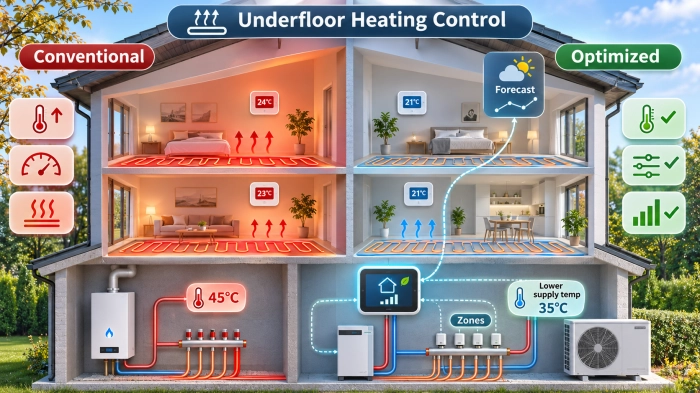
Underfloor heating is one of the most comfortable and, when properly designed, energy-efficient heating solutions. However, its advantages can only be fully realised when the control strategy takes into account the system's high thermal inertia, the building's changing heating demand and the different characteristics of individual rooms.
The objective of optimising underfloor heating is not simply to reduce energy consumption, but also to maintain more consistent indoor temperatures, minimise overheating and underheating, and provide more favourable operating conditions for the boiler or heat pump.
Conventional radiator heating responds relatively quickly to changes in heating demand. Underfloor heating, in contrast, heats a substantial part of the floor structure, which can store a considerable amount of thermal energy.
Several hours may pass between the start of heating and a noticeable increase in room temperature. Even after the heating has been switched off, the floor continues to release stored heat.
Control settings that work well with radiator heating may therefore not be suitable for underfloor heating without modification.
→ Why does underfloor heating overheat?
One of the main advantages of underfloor heating is that its large heat-emitting surface allows it to meet the building's heating demand using relatively low supply water temperatures.
Excessively high supply water temperatures heat the floor structure more quickly but can also increase the risk of overheating. After the heating has been switched off, more thermal energy than necessary may remain stored within the floor.
In properly designed underfloor heating systems, supply water temperatures are often between 25 and 40 °C. However, the required temperature always depends on the characteristics of the building and heating installation.
Lower supply water temperatures can provide several additional benefits:
The optimum supply water temperature is the lowest temperature that can still maintain the desired indoor temperature under the prevailing outdoor conditions. Permitted temperature limits for the floor structure and floor coverings must always be respected.
A building's heating demand depends significantly on the outdoor temperature. The colder it is outside, the more thermal energy is generally required to maintain the desired indoor temperature.
Weather-compensated heating control automatically adjusts the supply water temperature according to outdoor conditions.
The following table shows an illustrative heating curve:
| Outdoor temperature | Supply water temperature |
|---|---|
| +15 °C | 25 °C |
| +5 °C | 30 °C |
| -5 °C | 35 °C |
| -15 °C | 40 °C |
The values shown in this table are illustrative and are not universally applicable settings. The appropriate heating curve must be determined according to the building's heat loss, the design of the underfloor heating system and practical operating experience.
A correctly configured heating curve can help underfloor heating operate with longer, more consistent heat delivery instead of short periods of intensive heating.
Individual underfloor heating circuits may differ in length, hydraulic resistance and the heating demand of the rooms they serve. Applying the same water flow rate to every heating circuit is therefore not necessarily appropriate.
Without proper hydraulic balancing, shorter circuits with lower hydraulic resistance may receive too much water, while circulation through longer circuits may be insufficient.
Possible consequences include:
Flow meters and balancing valves located on the underfloor heating manifold allow the water flow rate of individual circuits to be adjusted according to their design requirements.
Intelligent heating control does not replace proper hydraulic balancing. The two approaches complement each other and can provide more favourable operating conditions.
With radiator heating, it is relatively easy to reduce room temperatures by several degrees overnight and restore comfortable temperatures within a short period the following morning.
With high-thermal-inertia underfloor heating, this strategy does not always work as intended. The effect of the night-time temperature setback may be delayed, while restoring the desired comfort temperature in the morning may take considerably longer.
Excessively large target temperature changes may result in:
For underfloor heating, more consistent operation and a smaller difference between comfort and economy target temperatures may therefore be beneficial.
Larger temperature setbacks may still be appropriate during extended periods of absence. The most suitable strategy depends on the building's thermal characteristics and occupancy patterns.
Switching hysteresis determines the temperature difference at which the controller switches heating on or off.
Excessively large hysteresis can result in significant indoor temperature fluctuations. Excessively small hysteresis, however, may cause unnecessarily frequent valve or heat source switching in certain installations.
When selecting suitable settings, the following factors should be considered:
Fine-tuning switching hysteresis alone does not eliminate the delay caused by the thermal inertia of underfloor heating, but it can contribute to more balanced temperature control.
Heating requirements can vary considerably between different rooms within the same building.
A south-facing living room may benefit from natural solar heat gains, while north-facing rooms may continue to require heating.
These differences are difficult to manage effectively using a single central thermostat.
Multi-zone heating control allows each room to have its own temperature sensor and individual target temperature. Underfloor heating circuits can be controlled separately using motorised actuators installed on the heating manifold.
A central controller can determine which heating circuits should remain open and when the boiler or heat pump should operate according to the heating demand of individual rooms.
Individual room temperature control can be particularly beneficial in:
As individual rooms reach their target temperatures, their corresponding heating circuits close. When only one small heating circuit remains open, the available water flow rate and heat-emitting surface may become insufficient for the boiler or heat pump.
When implementing multi-zone heating control, the minimum operating output of the heat source, its minimum water flow requirements and the hydraulic design of the installation must therefore also be considered.
Indoor temperatures are not determined exclusively by the heating system and outdoor air temperature. Solar radiation, household appliances and building occupants also introduce thermal energy into individual rooms.
In buildings with large windows, sunlight can provide considerable natural heat gains. If underfloor heating continues operating at the same intensity, overheating may occur.
Coordinating intelligent shading with individual room temperature control can help make better use of natural solar heat gains during winter while reducing the risk of overheating.
In addition to intelligent heating control, the Szélessáv Smart Home system also supports automatic roller shutter and shading control.
→ Automatic roller shutter and shading control
Another way to optimise underfloor heating is to use a control strategy that considers not only current temperatures but also the weather conditions expected over the next few hours.
Conventional weather-compensated heating control typically adjusts the supply water temperature according to the currently measured outdoor temperature. Although this can provide favourable operating conditions, it does not necessarily prepare the heating system for upcoming weather changes.
Predictive heating control, in contrast, can modify the switching conditions of individual heating zones before the expected outdoor temperature change actually occurs.
The objective is not to eliminate the thermal inertia of underfloor heating, but to take it into account and use it to the system's advantage wherever possible.
DSVT (Dual Smart Virtual Thermostat), developed by the Szélessáv Public Benefit Foundation, is an open-source heating and cooling control system that combines multiple control strategies within a single coordinated system.
One of its key features is the ability to adjust heating and cooling switching thresholds in advance according to the difference between current and expected outdoor temperatures.
The look-ahead period is configurable, allowing the control strategy to be adapted to the response time of the building and its underfloor heating system.
Additional DSVT features include:
The system runs locally within Domoticz, is open source and does not require mandatory manufacturer cloud services or subscription fees. Internet access is required to obtain updated weather forecast data.
→ Discover the DSVT predictive multi-zone heating and cooling control system
Implementing effective heating control does not end with the installation of thermostats and control devices. To achieve optimum operation, it is worth monitoring system behaviour over an extended period.
Displaying the following information together can be particularly useful:
The dedicated DSVT HTML interface provides a graphical overview of important control events from the previous 24 hours. This makes it easier to identify when individual rooms requested heating, when the controller intervened and how indoor temperatures changed in response.
Due to the high thermal inertia of underfloor heating, settings should be adjusted gradually, allowing sufficient time to observe the effect of each change. Modifying several parameters simultaneously can make it difficult to determine which adjustment produced a particular result.
Many existing underfloor heating installations can be upgraded without replacing the entire pipework or modifying the floor structure.
If the individual heating circuits are connected through a suitable manifold, motorised valve actuators, wireless temperature sensors and a central intelligent heating controller can often be retrofitted to the existing installation.
The extent of the required modifications depends on the technical characteristics of the existing heating system. The hydraulic and electrical installation, as well as the heat source connections, must comply with applicable technical and safety requirements.
Effective underfloor heating control depends on several interconnected technical and control-related factors. Correct supply water temperatures, hydraulic balancing, individual room temperature control and consistent heating operation are all important.
Conventional control strategies can be further improved by using weather forecast information, allowing the heating system to prepare for changing outdoor conditions before they actually occur.
What makes underfloor heating intelligent is not the ability to control it from a smartphone, but its ability to deliver the required amount of thermal energy to the right room at the right time.
DSVT implements this approach by combining predictive heating control, multi-zone temperature regulation and coordinated operation of the entire heating system.
→ Learn more about the DSVT predictive heating and cooling control system