The primary purpose of a conventional room thermostat is to regulate the temperature of a particular room. DSVT, developed by the Szélessáv Public Benefit Foundation, is not simply a thermostat but an open-source control system designed to coordinate the operation of the entire building's heating, cooling and domestic hot water systems.
The main difference is not whether the heating can be controlled from a smartphone or computer, but what information the system uses to make control decisions and which mechanical components it can operate in a coordinated manner.
A basic room thermostat measures the surrounding air temperature, compares it with the configured target temperature and requests or stops heating accordingly.
Its operation is primarily based on three factors:
A conventional thermostat generally has no information about temperatures in other rooms, the operating states of individual heating circuits, the hydraulic operating conditions of the heat source or the weather changes expected over the next few hours.
This may be entirely appropriate for relatively simple heating installations. More complex mechanical systems, however, require considerably more control functions.
Programmable thermostats allow different target temperatures to be assigned to different times of day and days of the week.
Internet-connected smart thermostats may also provide additional features:
These features can significantly improve the usability of conventional thermostats. However, a smart thermostat is not necessarily capable of coordinating every component of the building's mechanical installation.
Advanced commercial multi-zone systems are also available, offering additional mechanical control functions beyond those listed above. DSVT primarily distinguishes itself through its open, flexible and locally operated approach.
The ability to adjust a thermostat's target temperature from a smartphone does not necessarily change the underlying temperature control algorithm.
The real value of intelligent heating control lies in the system's ability to determine appropriate control actions autonomously, using the information available to it.
In a conventional thermostat, the temperature sensor, control electronics, user interface and switching component are generally integrated into a single physical device.
With DSVT, these functions can be distributed across independent devices and software components.
The thermostat is therefore not necessarily a separate wall-mounted device, but a temperature control function implemented within the central automation system.
One important advantage of this approach is that temperature sensors, actuators and control software can be replaced or upgraded independently, provided that the new components are compatible with the system.
A conventional central room thermostat generally determines heating demand according to the temperature measured at a single location within the building.
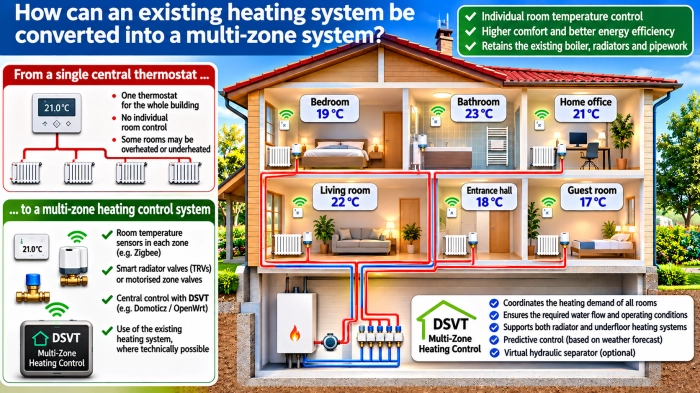
DSVT supports up to 12 independent heating and cooling zones. Separate temperature sensors, target temperatures and actuators can be assigned to each zone.
For example, the following target temperatures can be configured in a residential building:
| Room | Comfort temperature | Economy temperature |
|---|---|---|
| Living room | 22 °C | 20 °C |
| Bedroom | 20 °C | 18 °C |
| Bathroom | 23 °C | 20 °C |
| Home office | 22 °C | 19 °C |
| Guest room | 21 °C | 17 °C |
The temperatures shown in the table are illustrative examples. Actual settings should be adapted to the characteristics of the building and individual comfort requirements.
Based on the requirements of individual rooms, DSVT determines which heating circuits should operate and when the central heat source should be activated.
→ How can an existing heating system be converted into a multi-zone system?
One of the most important features of DSVT is its weather forecast-based predictive heating and cooling control.
A basic thermostat intervenes when the room temperature has already changed sufficiently to trigger a switching action.
DSVT, in contrast, can also consider outdoor temperatures expected over the next few hours and adjust the switching thresholds of individual heating and cooling zones in advance.
This is particularly important for high-thermal-inertia underfloor, wall and ceiling heating systems, which cannot respond immediately to control actions.
For example, if a significant increase in outdoor temperature is expected over the next few hours, the system can reduce heating demand earlier, taking advantage of the thermal energy already stored in the floor structure.
When a temperature drop is expected, compensation in the opposite direction can be applied, allowing the heating system to prepare earlier for the anticipated increase in heating demand.
The look-ahead period is configurable, allowing the control strategy to be adapted to the response time of the building and its heat distribution system. DSVT does not automatically learn a complete thermal model of the building, but instead uses configurable weather forecast-based compensation.
→ What is the difference between weather-compensated and predictive heating control?
→ Why does underfloor heating overheat?
The primary purpose of a conventional thermostat is to determine whether heating is required. It generally does not examine how many heating valves are open or whether sufficient heat-emitting surface is available for the boiler or heat pump to operate correctly.
In multi-zone heating systems, however, there may be situations where only one small room requires heating while all other heating circuits are closed.
This can result in insufficient water circulation, rapidly increasing supply water temperatures, frequent heat source starts and unfavourable operating conditions.
One of the specialised features of DSVT allows additional reserve circuits to be assigned to individual heating and cooling zones.
When a smaller zone independently requests heating or cooling, additional predefined circuits can also be opened according to the configuration, potentially increasing the available water flow rate, active water volume and heat-emitting surface.
The system therefore addresses not only individual room comfort requirements but also supports more favourable operating conditions for the heat source.
The Virtual Hydraulic Separator is a software-based control function, not physical hydraulic separation or a control system based on direct water flow measurements. It requires an appropriate hydraulic design and does not replace mechanical or safety components specified by the heat source manufacturer.
→ Detailed operation and configuration of the DSVT Virtual Hydraulic Separator
→ Is a hydraulic separator necessary in multi-zone heating systems?
→ Why is the minimum water flow rate important in heating systems?
DSVT can operate in both heating and cooling modes. Different heating and cooling target temperatures can be assigned to individual rooms.
Using appropriately integrated devices, the system can control various cooling solutions:
Heating and cooling can be managed within the same control system, allowing operating modes and mechanical equipment to be coordinated.
In radiant cooling installations, appropriate humidity and dew point monitoring, together with condensation protection, is particularly important.
When modernising existing residential heating installations, homeowners may choose to install a heat pump while retaining their existing gas boiler.
When two independent thermostats are used, the heat sources may operate independently of each other, which does not necessarily provide appropriate or economical operating conditions.
DSVT allows the heat pump and gas boiler to operate as components of a common control system.
Heat source selection can take various factors into account, including:
In addition to controlling the heat sources, the central controller can also coordinate the operation of associated circulation pumps and motorised valves.
DSVT is not limited to individual room temperature control. It can also control domestic hot water storage tanks and buffer tanks that share a common heat source with the heating system.
Different operating modes and target temperatures can be configured for domestic hot water production.
This allows space heating, cooling and domestic hot water production to operate as coordinated parts of the same system rather than as independent functions.
Conventional time schedules modify target temperatures at predefined times, regardless of whether anyone is actually present in the building.
Using appropriate presence information, DSVT can apply different comfort and economy operating modes.
The Szélessáv Smart Home Presence Switch can use the presence of predefined network devices connected to an OpenWrt router to help determine the occupancy status of the building.
The objective is to adapt heating and cooling operation to the actual use of the building wherever possible, rather than relying exclusively on a fixed weekly schedule.
→ How the Szélessáv Presence Switch works
During ventilation or when a window remains open for an extended period, a conventional thermostat may increase heating demand as the room temperature decreases.
DSVT can also consider the status of door and window sensors assigned to individual zones.
With an appropriate configuration, the system can restrict heating or cooling in the affected zone during ventilation and return to normal operation after the window has been closed.
Temperature control in other rooms can continue independently.
A conventional room thermostat generally has no information about the building's electricity generation or consumption.
When suitable energy measurement data is available, DSVT can also take surplus photovoltaic energy into account.
This creates opportunities to use some of the locally generated electricity in the form of thermal energy.
Depending on the system configuration, possible applications include:
When utilising surplus energy, comfort requirements, permitted temperatures and the operating limitations of mechanical equipment must always be respected.
In more complex heating installations, simply activating the heat source is not sufficient to ensure correct system operation.
Different circulation pumps, motorised valves and mixing valves may also need to operate in an appropriate sequence.
DSVT supports various mechanical control functions, including:
This is particularly important in existing heating installations containing both radiators and underfloor heating circuits, multiple heat sources or heating circuits operating at different supply water temperatures.
In addition to normal temperature regulation, DSVT provides supplementary functions that support the operation and protection of mechanical equipment.
The configurable frost protection function can provide additional protection for the heating system when specified temperature conditions occur.
Circulation pumps and motorised valves that remain inactive for extended periods may become stuck or seize.
DSVT allows selected devices to be operated briefly at weekly intervals. The timing and duration of this periodic operation are configurable.
These functions provide supplementary software-based protection. They do not replace the internal safety and protection systems of boilers, heat pumps or other mechanical equipment.
A conventional thermostat display generally shows the current room temperature, target temperature and heating status.
However, this information does not necessarily explain why or how frequently the heating system has intervened over the previous few hours.
The dedicated DSVT HTML interface provides a graphical overview of important control events and operating data from the previous 24 hours.
Depending on the configured devices, the following information can be monitored:
This not only supports everyday system operation but also provides an important tool for troubleshooting, energy efficiency optimisation and fine-tuning control parameters.
| Feature | Conventional room thermostat | Typical smart thermostat | DSVT |
|---|---|---|---|
| Room temperature control | Yes | Yes | Yes |
| Remote access and control | Typically no | Yes | Yes |
| Multi-zone temperature control | Separate devices required | System-dependent | Up to 12 zones |
| Combined heating and cooling control | Model-dependent | Model-dependent | Yes |
| Weather forecast-based predictive control | Typically no | Model-dependent | Yes |
| Configurable look-ahead period | No | Model-dependent | Yes |
| Virtual Hydraulic Separator | No | System-dependent, alternative solutions | Yes |
| Coordinated gas boiler and heat pump control | Typically no | System-dependent | Yes |
| Domestic hot water control | Typically no | Model-dependent | Yes |
| Buffer tank control | No | System-dependent | Yes |
| Mixing valve control | Typically no | System-dependent | Two independent mixing valves |
| Presence-based control | Typically no | Model-dependent | Yes |
| Open window detection | Typically no | Model-dependent | Yes |
| Surplus photovoltaic energy utilisation | No | System-dependent | Supported |
| Periodic circulation pump and valve operation | Typically no | System-dependent | Yes |
| Mandatory manufacturer cloud service | No | Manufacturer-dependent | No |
| Open-source control software | Typically no | System-dependent | Yes |
| Monthly software subscription | No | Manufacturer-dependent | No |
The table compares general categories of heating control systems rather than individual products from specific manufacturers. The capabilities of advanced commercial thermostats and comprehensive building services control systems may vary considerably. Some DSVT functions require appropriate sensors, actuators and mechanical installation design.
Heating and cooling are fundamental building services. Wherever possible, their operation should not depend on the availability of a remote manufacturer-operated server.
Many internet-connected smart home devices rely on manufacturer cloud services. Discontinuation of these services, internet connection failures or changes to service conditions may result in the loss of certain functions.
DSVT, in contrast, runs locally within the user's own Domoticz installation.
When devices supporting appropriate local communication are used, this approach provides several advantages:
Internet access is, of course, required to obtain updated online weather forecasts and use other external internet-based services.
The Szélessáv Smart Home system is built around two open-source software platforms: the OpenWrt operating system and the Domoticz home automation platform.
A suitable OpenWrt router can operate as the central home automation controller while continuing to provide conventional network services.
This allows several services to be implemented on a single suitable hardware device:
DSVT is also available as a standalone Domoticz plugin and can be used with other compatible Domoticz installations. Using the OpenWrt firmware provided by Szélessáv can simplify the installation and integration of the complete system.
Domoticz supports the integration of numerous communication protocols and device types.
The heating control system can therefore be built using compatible Zigbee sensors, Wi-Fi devices, relays running Tasmota firmware, smart thermostatic radiator valves and other supported equipment.
The central component of the system is the control software, not a closed hardware ecosystem belonging to a single manufacturer.
No. In a small apartment with a single heating zone or a relatively simple radiator heating installation, an appropriately selected conventional or programmable thermostat may be entirely sufficient.
The benefits of DSVT are most apparent in buildings and heating installations where several different control functions need to be coordinated.
Its application may be particularly beneficial in the following situations:
DSVT provides considerably more configuration options than a basic room thermostat. Consequently, it requires more detailed initial configuration and an assessment of the existing mechanical installation.
However, it is not necessary to use every available function immediately.
The system can initially be implemented with a single heating zone and basic boiler control, then gradually expanded with additional zones, heat sources and automation functions.
The dedicated DSVT HTML interface assists with configuration, meaning that normal operating parameters can be adjusted without modifying the Python source code.
However, installing mechanical and electrical connections may require appropriate professional knowledge and qualifications.
DSVT is open-source software available free of charge. There are no separate software licence fees or mandatory monthly subscriptions.
The total system cost is primarily determined by the required hardware, temperature sensors, relays, motorised valves and any necessary mechanical modifications.
When a compatible router, Domoticz installation and home automation devices are already available, implementing DSVT may require relatively little additional investment.
For a single heating zone, a conventional thermostat may provide a simpler and less expensive solution. However, in multi-zone heating installations and complex mechanical systems, the overall system cost and functionality should be compared rather than simply the purchase price of an individual thermostat.
→ How much does the Szélessáv Smart Home system cost and what equipment is required?
A conventional room thermostat primarily determines heating demand according to the temperature of a particular room. Programmable and smart thermostats can extend this basic functionality with various convenience and control features.
DSVT takes a more comprehensive approach by coordinating independent heating and cooling zones, different heat sources, motorised valves, circulation pumps, mixing valves and domestic hot water production within a single central control system.
Two particularly important features are weather forecast-based predictive control and the Virtual Hydraulic Separator. These functions help address the specific challenges of high-thermal-inertia radiant heating systems and retrofitted multi-zone heating installations.
A conventional thermostat determines whether heating is required. DSVT goes further by determining where and when heating or cooling is required, which heat source should be used and how the associated mechanical components should operate together.
All of this is provided through an open-source, locally operated and gradually expandable system, without mandatory manufacturer cloud services or monthly subscription fees.
→ Discover the DSVT predictive multi-zone heating and cooling control system