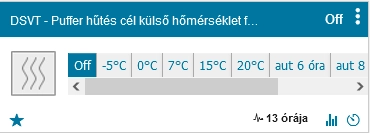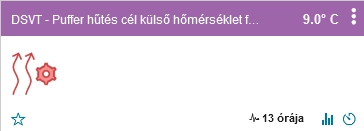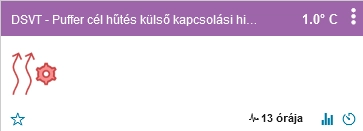
DSVT allows domestic hot water (DHW) and buffer tank control to adapt to outdoor temperature conditions. The primary objective is to improve energy efficiency, particularly in installations where the efficiency of the heat-generating equipment, such as an air-to-water heat pump, depends significantly on outdoor temperature.
The principle is that the system does not always operate with the same target temperature and hysteresis settings. Instead, it can adjust these parameters according to outdoor conditions. This makes it possible to shift thermal energy production and storage to more favourable periods.
Outdoor temperature-based control supports two main methods:
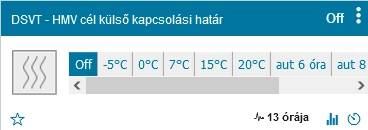
In this mode, DSVT monitors the measured outdoor temperature. When the configured threshold is reached or exceeded, the system can switch to an alternative target temperature and hysteresis setting.
This can be particularly useful when favourable outdoor temperatures make it desirable to produce and store additional domestic hot water or thermal energy for heating and cooling.
This setting defines the outdoor temperature threshold above or below which the system can switch to the alternative outdoor-temperature-dependent DHW control settings.
It allows the user to determine under which outdoor temperature conditions the DHW tank target temperature and associated hysteresis should be adjusted.
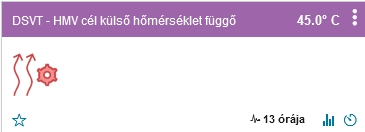
When this function is enabled, DSVT can use an outdoor-temperature-dependent target value instead of the normal DHW target temperature.
In practice, this means that the system can apply a different DHW tank temperature under more favourable outdoor temperature conditions.
This allows domestic hot water production to be better aligned with the operating conditions in which the heat-generating equipment is more efficient.
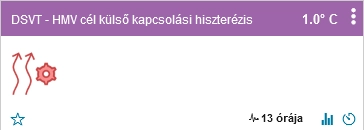
Switching hysteresis prevents the system from switching too frequently between normal and outdoor-temperature-dependent control when the outdoor temperature fluctuates around the configured threshold.
Appropriate hysteresis settings provide more stable operation and reduce unnecessary switching.
For example, when outdoor conditions remain favourable, the system may apply a higher DHW target temperature or a different hysteresis setting to support more efficient thermal energy storage.
The second control method does not rely solely on the current outdoor temperature. Instead, it uses available weather forecast data to identify more favourable periods during the day.
For example, the controller can identify the hours expected to be warmer or cooler and apply modified target temperatures during the selected periods.
This approach is particularly useful when thermal energy production should be scheduled according to the expected daily temperature profile rather than a single fixed outdoor temperature threshold.
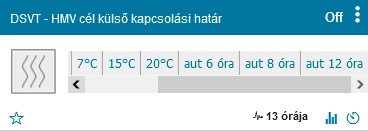
In this mode, DSVT applies the outdoor-temperature-dependent DHW target settings during the selected period calculated from weather forecast data.
This allows the system to produce and store additional domestic hot water during periods when the heat source is expected to operate more efficiently.
Buffer tank control follows a similar principle to DHW control, but the modified target values are used for storing heating or cooling energy.
The objective is to adapt the temperature and amount of energy stored in the buffer tank to outdoor conditions and anticipated demand.
In cooling mode, the system can reduce the buffer tank target temperature according to outdoor temperature or a selected forecast-based period when conditions are favourable for producing cooling energy.
This allows colder water to be stored in the tank for later use in cooling the building.
This parameter defines the target temperature applied when outdoor-temperature-dependent control becomes active according to the configured temperature conditions or selected time period.
By deliberately setting different normal and outdoor-temperature-dependent target values, buffer tank operation can be shifted towards periods with potentially better energy efficiency.
Here, hysteresis also prevents excessively frequent switching between normal and outdoor-temperature-dependent buffer tank control.
Appropriate settings help balance stable operation with opportunities to improve energy efficiency.
Outdoor temperature-based DHW and buffer tank control can help shift thermal energy production to periods with more favourable operating conditions.
This can be particularly beneficial for:
The objective of intelligent control is not only to optimise immediate operation but also to make more effective use of available energy sources and thermal storage capacity.
However, the actual energy savings depend on the equipment's efficiency, storage losses, the required water temperatures, and the building's heating or cooling demand.
DSVT outdoor temperature-based control allows DHW and buffer tank target temperatures to adapt to current or forecast outdoor conditions.
Fixed outdoor temperature thresholds, switching hysteresis settings, and forecast-based operating periods are available for this purpose.
Properly configured outdoor temperature-based control can contribute to improved energy efficiency, more effective use of thermal storage, and more balanced system operation.