DSVT's compensation circulation function helps reduce temperature differences between rooms without activating the heating or cooling heat sources.
This function can be particularly useful in buildings where room temperatures vary significantly due to solar radiation, building orientation, or differences in internal heat gains.
For example, in a south-facing living room exposed to sunlight, the temperature may exceed the configured heating target while north-facing rooms remain considerably cooler.
Similar temperature differences can occur in multi-storey buildings, where upper floors may generally be warmer than lower floors.
The purpose of compensation circulation is to redistribute thermal energy between rooms by circulating water through the heating or cooling circuits, provided that the hydraulic system is designed to support this operation.
DSVT determines the lowest and highest room temperatures from the temperature sensors assigned to this function.
The difference between these two values determines whether compensation circulation should be activated.
The calculation is:
Temperature Difference = Highest Room Temperature − Lowest Room Temperature
If the calculated difference reaches or exceeds the configured threshold, and the heating and cooling heat sources are inactive, DSVT activates the output assigned to compensation circulation.
When the temperature difference falls below the configured threshold, circulation is switched off.
The function also disables compensation circulation whenever a controlled heating or cooling heat source becomes active.
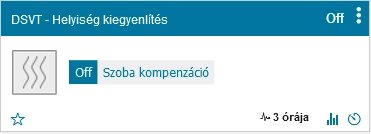
The function can be enabled using the Room leveling selector switch in Domoticz.
The available operating modes are:
When enabled, DSVT evaluates the circulation conditions during its normal control cycles.
The function can operate independently without requesting additional heating or cooling output from a heat source.
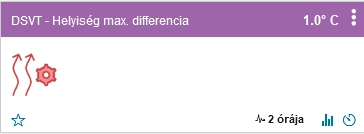
The Room max. difference parameter specifies the temperature difference, in degrees Celsius, at which compensation circulation is activated.
DSVT compares this threshold with the difference between the highest and lowest temperatures measured in the participating rooms.
For example:
The actual temperature difference is:
24.0 − 21.0 = 3.0°C
Since the 3.0°C difference exceeds the configured 2.0°C threshold, DSVT activates compensation circulation if the function is enabled and the heat sources are inactive.
If the temperature difference subsequently falls below 2.0°C, the controller switches circulation off.
Important: the current control logic does not use separate activation and deactivation hysteresis for this temperature difference. Therefore, temperature fluctuations around the configured threshold may cause more frequent switching.
Compensation circulation requires temperature measurements from at least two different rooms to determine a meaningful temperature difference.
DSVT uses temperature sensors assigned through the L: identifier in its hardware configuration.
Multiple temperature sensors can be configured. In this case, the controller selects the highest and lowest values from all valid measurements.
During calculation, DSVT checks the validity of sensor data and excludes measurements that have become invalid due to communication timeouts from the current temperature list.
Sensors should preferably be installed in rooms where significant temperature differences may occur and whose heating or cooling circuits can participate in compensation circulation.
DSVT identifies the switching devices assigned to compensation circulation through the L: configuration in the hardware settings.
This configuration allows one or more Domoticz switching outputs to be controlled.
For example, these outputs can operate relays connected to circulation pumps.
When the conditions for compensation circulation are met, DSVT sends an ON command to the assigned devices.
When these conditions are no longer met, an OFF command is sent.
The system also maintains a separate internal status device to indicate whether compensation circulation is operating.
Important: switching on a circulation pump does not automatically guarantee heat transfer between rooms. Suitable hydraulic connections, open flow paths, and sufficient water circulation are required.
DSVT handles compensation circulation separately from its normal heating and cooling heat source control.
The function can operate when the primary and secondary heating and cooling heat sources controlled by the system are inactive.
If any of these heat sources becomes active, DSVT switches off the compensation circulation output.
This prevents compensation circulation from operating independently at the same time as normal heating or cooling production.
Compensation circulation is not intended to replace individual room or zone control. Instead, it serves as a supplementary function.
During the heating season, compensation circulation may be particularly beneficial in buildings where some rooms become warmer than others because of solar radiation or internal heat gains.
For example, an underfloor heating circuit in a sunlit living room may be warmer than a circuit serving a north-facing room.
With an appropriately designed hydraulic system, circulation may allow some of the thermal energy stored in the warmer circuit to be transferred through other heat distribution circuits.
This can help reduce temperature differences between rooms without immediately requiring additional heat production.
The actual effect depends on the pipework configuration, heat transfer surfaces, and water flow through the individual circuits.
Compensation circulation can also be used during summer when significant temperature differences develop between different rooms.
For example, a shaded room may be cooler than a room with large windows exposed to direct sunlight.
With an appropriately designed water circulation system, some of this temperature difference may be reduced through passive redistribution of thermal energy.
However, without actively producing cooling energy, the system can only make use of temperature differences that already exist.
Therefore, the expected cooling effect is generally considerably smaller than during active cooling with a heat pump or another cooling source.
Radiant cooling circuits must still maintain appropriate dew point protection and condensation prevention measures.
The effectiveness of compensation circulation depends significantly on the design of the heat distribution system.
Underfloor heating and other large-area systems can provide favourable conditions for redistributing thermal energy because of their extensive heat transfer surfaces and the thermal storage capacity of the building structure.
Radiator systems may provide more limited benefits due to their smaller heat transfer surfaces and the relatively small temperature differences available during passive circulation.
A key requirement is that the circulating water must be able to absorb heat from warmer rooms and release it in cooler rooms.
If the hydraulic system cannot support this process, operating the circulation pump may not produce meaningful room temperature balancing.
The main advantage of compensation circulation is that it attempts to improve thermal energy distribution without activating a heating or cooling heat source.
However, the circulation pump itself consumes electricity.
Actual energy efficiency therefore depends on whether transferring heat between rooms sufficiently reduces the need for subsequent active heating or cooling.
Under suitable conditions, compensation circulation may:
Before enabling this function, it is advisable to assess whether the expected improvement in temperature balancing justifies the additional electricity consumption of the circulation pump.
DSVT's compensation circulation function controls one or more assigned circulation outputs according to the temperature difference between rooms.
The controller compares the highest and lowest temperatures from the assigned sensors and can activate circulation when the configured threshold is reached.
The function operates only when compensation mode is enabled and the controlled heating and cooling heat sources are inactive.
With an appropriately designed hydraulic system, compensation circulation can help redistribute thermal energy between different rooms.
The purpose of this function is to reduce room temperature differences and make better use of available thermal energy without unnecessarily activating heating or cooling heat sources.