DSVT's energy balance-based control allows heating, cooling, and domestic hot water (DHW) production to adapt to the building's current electrical energy balance.
This function is particularly useful in buildings equipped with solar photovoltaic (PV) systems, where electricity generation may periodically exceed the building's instantaneous consumption.
Based on the available surplus electricity, DSVT can adjust heat source selection and the intensity of thermal energy production.
The objective is to increase the proportion of locally generated electricity consumed within the building and, where practical, reduce electricity exported to the grid.
The system provides two main control options:
These two control methods can be used independently or in combination.
In a solar PV installation, the building's electrical energy balance is determined by the difference between electricity generation and instantaneous consumption.
When the solar panels generate more electricity than the building consumes, the remaining power may be exported to the electricity grid.
When consumption exceeds generation, the building imports the additional electricity required from the grid.
DSVT can take this instantaneous balance into account using data provided by a suitable electricity meter.
Important distinction: total solar PV generation is not the same as the electricity surplus available for use. For control purposes, the relevant measurement is primarily the electricity imported or exported at the grid connection point.
For example:
If the electricity consumption of a controllable device is appropriately matched to this surplus, switching it on can increase local consumption of solar-generated electricity.
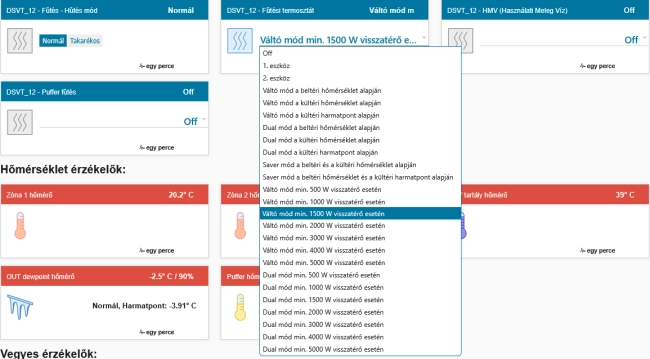
DSVT allows the operation of two configured heat sources to depend on a specified electrical power threshold.
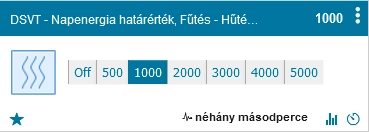
A threshold expressed in watts can be configured for heat source selection. The controller compares this threshold with the instantaneous electrical energy balance.
The available control strategies include Changeover and Dual modes.
In Changeover mode, DSVT selects the heat source according to the electrical power balance.
For example, Heat Source 1 may be an electrically powered heat pump, while Heat Source 2 may be a gas boiler.
The most economical operating strategy depends on current energy prices and the efficiency of the available equipment.
In Dual mode, the two heat sources can operate as follows:
Dual mode allows both heat sources to be used together, provided that the hydraulic configuration and equipment operating requirements permit simultaneous operation.
Important: selecting a heat source according to the available solar electricity surplus does not necessarily guarantee the lowest operating cost. Actual savings also depend on the heat pump's coefficient of performance (COP), energy prices, and the efficiency of the alternative heat source.
Solar PV generation can change significantly over short periods, for example due to passing clouds or changes in building electricity consumption.
If the controller responded immediately to every small power fluctuation, heat sources could switch on and off excessively frequently.
To reduce this behaviour, DSVT provides percentage-based hysteresis associated with the power threshold.
Hysteresis creates a difference between the switching-on and switching-off conditions, reducing unnecessary switching around the configured threshold.
Another important consideration is that switching on an electrical device immediately reduces the amount of electricity exported to the grid.
If this effect were ignored, the surplus could fall below the switching threshold immediately after the device starts, causing the controller to switch it off again.
Once the device stops, grid export would increase, potentially triggering another switching-on cycle.
DSVT's switching logic aims to reduce this effect by taking the configured power limit into account.
Consider the following situation:
The controller switches on the device because the exported power exceeds the configured threshold.
After the device starts, assuming solar generation and other consumption remain unchanged, grid export becomes:
600 W − 450 W = 150 W
If the controller compared only this new value with the original 500 W switching-on threshold, unnecessary switching cycles could occur.
The compensation associated with the configured power limit, together with hysteresis, is intended to provide more stable operation.
The threshold should be selected with reference to the expected electrical power consumption of the controlled equipment.
In addition to switching heat sources, DSVT can adjust temperature control targets according to the available surplus electricity.
This function can be applied in four areas:
This allows the building and water storage tanks to act partly as thermal energy storage systems, storing either heat or cooling energy.
The objective is to produce additional thermal energy or cooling during favourable electricity balance conditions, potentially reducing the need for further energy consumption later.
In DSVT's Miscellaneous settings, users can configure the power threshold at which energy balance-based target temperature compensation becomes active.
During heating, the controller can increase the effective target temperature using the configured compensation value.
During cooling, reducing the target temperature allows additional cooling energy to be stored in the building's thermal mass or associated cooling system.
In both cases, the compensation must remain within acceptable comfort limits and the equipment's permitted operating range.
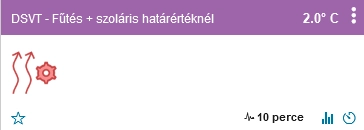
This setting determines the positive temperature correction applied when sufficient surplus electricity is available.
For example, a higher effective heating target can temporarily be used instead of the normal 21°C setting.
Some of the additional heat stored in the building can then remain available after solar PV generation decreases.
Target temperature compensation can also be coordinated with scheduled operation.
For example, when sufficient electricity surplus is available:
These times and values are illustrative. Actual settings should be adapted to comfort requirements, building thermal inertia, and expected electricity generation.
In buildings with high thermal inertia, avoiding excessive preheating is particularly important.
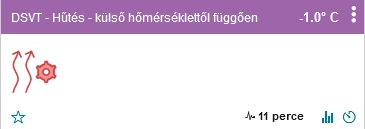
During cooling operation, the target temperature can similarly be reduced when sufficient surplus electricity is available.
This allows the building to be precooled, potentially reducing cooling demand later when solar generation is lower.
In radiant cooling installations, dew point-based condensation protection must remain active and effective.
Health-oriented cooling limits, zone comfort settings, and other safety conditions must also take priority over maximising the use of surplus electricity.
Domestic hot water production can be particularly suitable for making use of surplus electricity available during the day.
Hot water stored in a DHW tank remains available for later use, allowing the tank to act as a thermal energy store.
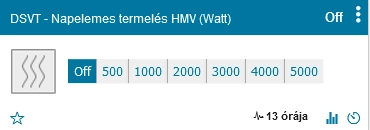
This parameter defines the electrical power threshold used for energy balance-based DHW control.
Depending on the available surplus electricity, the controller can apply a target temperature different from the normal DHW setting.
This allows more intensive domestic hot water production during periods with favourable electrical conditions.
The power threshold can be selected according to the consumption of the controlled equipment, such as a relatively low-power heat pump or a higher-power electric immersion heater.
The normal DHW target temperature can be configured to provide sufficient hot water for everyday use.
When adequate surplus electricity is available, DSVT can apply a higher target temperature, allowing additional thermal energy to be stored in the tank.
For example, heating 200 litres of water from 50°C to 60°C stores approximately:
200 × 10 × 0.001163 = 2.33 kWh
of additional thermal energy, excluding losses.
This energy can subsequently be used for domestic hot water supply.
Safety warning: increasing DHW storage temperature increases scalding risk and heat losses. Higher storage temperatures must remain within the permitted operating limits of the tank, heat source, and pipework. Where necessary, suitable thermostatic mixing valves and overheating protection must be provided.
Legionella risk management requirements must also be considered when configuring DHW storage temperatures.
A separate DHW hysteresis value can be configured for solar surplus operation.
This determines how far the tank temperature may deviate from the target before the controller requests heating again.
Appropriate hysteresis settings influence switching frequency and the behaviour of solar surplus-based DHW production.
Hysteresis that is too narrow may cause more frequent switching, while excessively wide hysteresis can result in larger tank temperature fluctuations.
Like a DHW tank, a buffer tank can store thermal energy, but its stored energy is intended for building heating or cooling.
DSVT supports energy balance-based buffer tank control in both heating and cooling modes.
When sufficient surplus electricity is available, the controller can apply alternative target temperatures and hysteresis values.
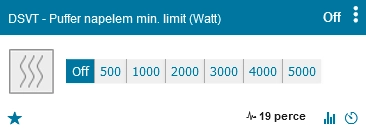
This parameter defines the electrical power threshold at which solar surplus-based buffer tank control can become active.
The threshold should be selected according to the expected electrical power consumption of the heat-generating equipment.
During heating operation, a higher buffer tank target temperature can be used when surplus solar electricity is available.
This allows additional thermal energy to be stored in the tank for later use in heating the building.
However, in heat pump systems, higher supply water and storage temperatures generally reduce the coefficient of performance (COP).
Therefore, the benefit of using surplus solar electricity should be evaluated together with the resulting change in heat pump efficiency.
During cooling operation, a lower buffer tank target temperature can be applied when surplus solar electricity is available.
This allows cooling energy to be stored in advance for use during subsequent periods.
The target temperature must be selected according to the cooling system design, condensation risk, and the heat source's permitted operating range.
A separate buffer tank hysteresis value can also be configured for solar surplus operation.
This determines the temperature range within which the buffer tank may operate between switching the heat source on and off.
Appropriate settings can help reduce frequent switching while allowing more effective utilisation of available surplus electricity.
Energy balance-based control requires measurement data from which the building's current electricity import or export can be determined.
One possible solution is an intelligent electricity meter equipped with a P1 interface, together with a compatible data collection device.
The P1 interface provides access to electrical measurement data from compatible smart meters.
A P1 data collector connected to Domoticz may provide information such as:
DSVT can use the appropriate power measurements for energy balance-based control.
Important: not every smart electricity meter has an accessible P1 interface. The essential requirement is reliable electrical power measurement available in Domoticz, with correct interpretation of import and export values.
Further information about compatible measuring devices and their integration is available in the documentation section "P1 Meter for Determining the Current Electrical Energy Balance".
One of the principal benefits of energy balance-based control is the opportunity to increase the proportion of locally generated electricity consumed within the building.
With suitable configuration, the following benefits may be achieved:
However, thermal energy storage also involves losses.
Higher DHW and buffer tank temperatures increase heat losses and may reduce heat pump efficiency.
Similarly, preheating or precooling a building is beneficial only when the stored energy is subsequently used.
Therefore, the objective of energy balance-based control is not necessarily to maximise electricity consumption whenever solar generation is available, but to increase the amount of energy that can be stored and used economically.
DSVT's energy balance-based control uses electrical power balance information to adjust heat source operation and heating, cooling, DHW, and buffer tank target temperatures.
Individually configurable power thresholds, hysteresis values, and target temperatures allow the system to adapt to building characteristics and available electricity generation.
This function can be particularly beneficial in solar PV installations where consuming locally generated electricity is more economical than exporting it to the grid.
When properly configured, energy balance-based control can increase solar self-consumption, reduce electricity imported from the grid, and support more economical use of available thermal energy storage capacity.