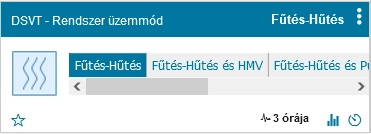
Thanks to its modular architecture, DSVT can be configured to match the technical characteristics of the building's heating and cooling installation and the user's individual requirements.
During configuration, users can choose from five different system operating modes. The selected mode determines which functions are enabled for heating and cooling, domestic hot water (DHW) production, and buffer tank control.
This approach prevents unused functions, switches, and parameters from unnecessarily cluttering the Domoticz user interface, making the system easier to navigate and configure.
In this mode, DSVT controls only the heating and cooling system.
It can be used for anything from a simple single-zone thermostat installation to systems with multiple heat sources and up to 12 independently controlled zones.
Domestic hot water and buffer tank control functions are disabled.
In addition to heating and cooling, the system also controls domestic hot water production.
DHW control provides separate target temperatures, heat source selection options, and additional control functions.
This mode is suitable when space heating, cooling, and domestic hot water production are managed within a single automation system.
In this mode, DSVT controls the heating and cooling system together with the temperature regulation of a buffer tank.
The buffer tank can have separate heating and cooling target temperatures, hysteresis settings, and heat source control options.
DHW control is disabled in this mode.
This is the most comprehensive DSVT operating mode, enabling heating and cooling, domestic hot water production, and buffer tank control simultaneously.
The three control functions can operate in coordination, taking into account their individual target temperatures, heating or cooling demands, and configured priorities.
This mode is particularly suitable for complex building services installations with multiple heat sources and independently controlled heating and cooling zones.
In this mode, only domestic hot water production control is enabled.
Heating, cooling, and buffer tank regulation functions are disabled.
This allows DSVT to operate as a standalone domestic hot water controller.
When the system operating mode is changed, DSVT re-evaluates the selected functions and updates the status of the corresponding Domoticz devices and parameters.
The required control elements become available, while devices associated with unused functions may be disabled or hidden from the user interface.
Processing these changes and refreshing the interface may take some time. In larger configurations, it is advisable to allow approximately 30–40 seconds before making further adjustments.
We recommend waiting for the mode change and configuration update to complete before continuing with additional settings.
DSVT offers a wide range of configuration options, so some device and parameter names are relatively long.
In the Domoticz user interface, longer descriptions may not always fit within the available display area.
Where supported by the interface, hovering the mouse pointer over a truncated label may display the full text in a tooltip.
Always read switch and parameter names carefully. Some settings differ by only a few words, even though they control entirely different functions.
It is particularly important to distinguish between parameters associated with heating, cooling, domestic hot water, and buffer tank control, as well as settings for the first and second heat sources.
By selecting the appropriate operating mode, DSVT can be adapted to both simple and complex heating and cooling installations.
Its modular design allows users to enable only the functions required for their particular installation.
This can provide a clearer user interface, simpler configuration, and a control system that is easier to maintain.