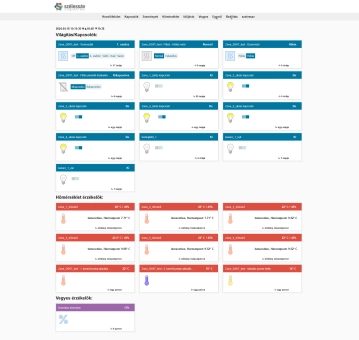
The DSVT intelligent heating, cooling and domestic hot water (DHW) control system is suitable for replacing conventional room thermostats in simple, single-zone heating installations, as well as automating complex, multi-zone building heating and cooling systems.
The system is designed to bring existing heating and cooling equipment under unified control, adapting its operation to the actual heating and cooling demand of individual rooms and environmental conditions. This helps improve comfort and reduce unnecessary energy consumption.
A single DSVT controller can manage up to 12 independent heating and cooling zones. Each zone can have its own temperature sensor, target temperature, switching device and control parameters.
The number of zones does not necessarily correspond to the number of rooms. A single zone may serve several rooms, while one room may contain multiple independently controlled heating or cooling circuits.
Individual zone control can be implemented using dedicated circulation pumps, motorised zone valves, thermoelectric actuators installed on heating manifolds, or suitable thermostatic radiator valves (TRVs).
The system supports two separate heat sources, which can be switched automatically according to the selected operating mode and control conditions.
This is particularly useful in installations combining, for example, a heat pump and a gas boiler. The controller can select the appropriate heat source based on predefined conditions.
DSVT can also manage domestic hot water (DHW) production and buffer tank operation. An electric immersion heater can be used as an additional heat source for DHW production.
DSVT does not rely exclusively on the current temperature of individual rooms. Depending on the selected operating mode, the control algorithms can also take into account outdoor temperature, relative humidity, calculated dew point and the thermal inertia of the building.
Different control modes allow the operation of heat sources and heating or cooling circuits to be adapted to current environmental conditions.
In heating mode, mixing valves can regulate the supply water temperature of individual heating circuits, for example when radiator heating and underfloor heating are used together.
In cooling mode, the risk of surface condensation can be reduced by taking into account the dew point calculated from room temperature and relative humidity. This is particularly important in underfloor, wall and ceiling cooling installations.
DSVT includes several additional control functions designed to reduce energy consumption while maintaining indoor comfort.
One of the key advantages of DSVT is that the entire heating and cooling installation does not necessarily need to be replaced. In many cases, existing equipment can be automated by adding suitable sensors and switching devices.
Underfloor heating systems offer particularly good opportunities for retrofitting individual zone control. Conventional valves on a heating manifold can be fitted with suitable thermoelectric actuators, allowing each heating circuit to be controlled independently.
Communication can be implemented through Wi-Fi, Zigbee and other devices supported by Domoticz. Wireless sensors and switching devices can often eliminate the need for opening walls or installing new cables, although wired solutions can also be used where appropriate.
The system is built on the open-source Domoticz home automation platform and can also run on an OpenWrt-based router.
Its modular architecture makes it possible to start with simple thermostat-based control and gradually expand towards a comprehensive, multi-zone heating, cooling and energy management system.
Not all features need to be used simultaneously. The controller can be configured to suit the mechanical and electrical characteristics of a particular building and, with an appropriate system design, can be expanded using additional controller units.
The purpose of DSVT is not to replace existing, functional equipment unnecessarily, but to provide intelligent, coordinated and energy-efficient control of the systems already installed.